KKG Thermoelectric Cooler Product Knowledge Center
Understanding Thermoelectric Cooling Technology, TEC Structure, Materials, Performance and Applications
Thermoelectric coolers (TECs), also known as Peltier coolers, Peltier modules, or thermoelectric cooling modules, are solid-state devices that provide precise temperature control without compressors or refrigerants.
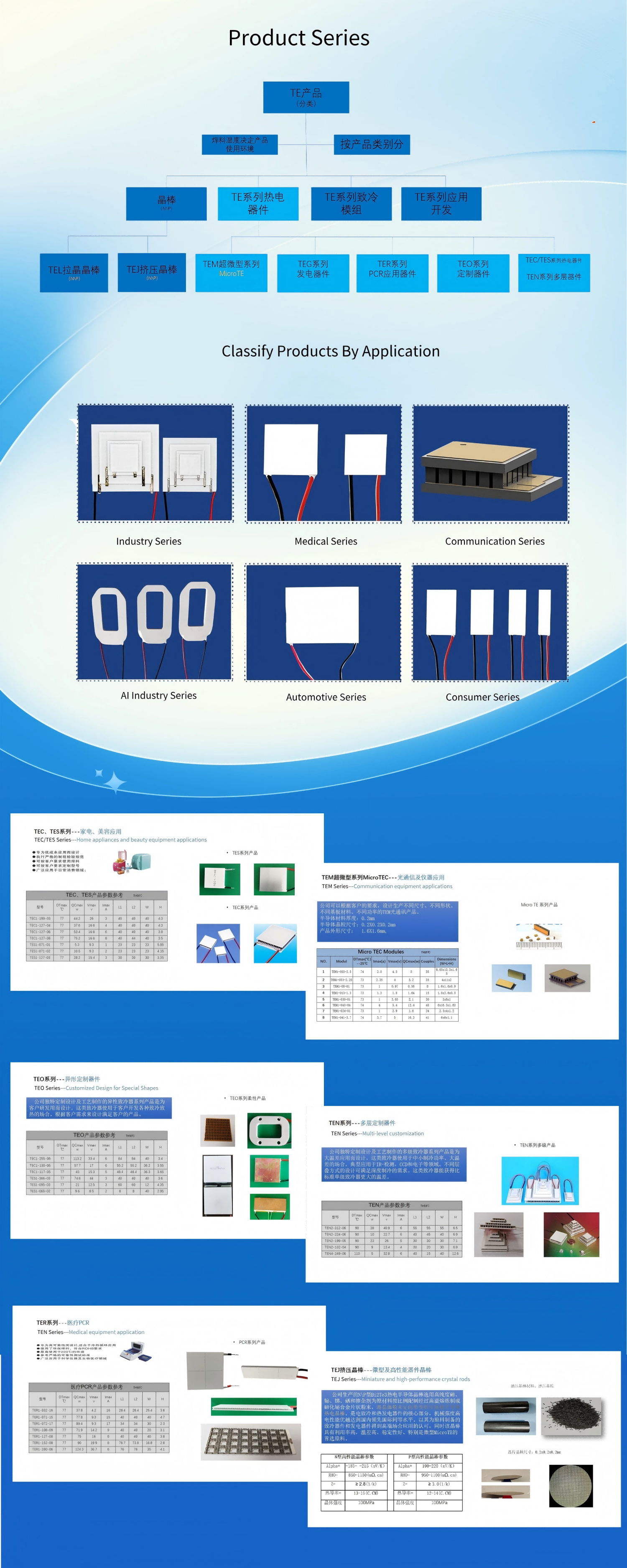
KKG develops and manufactures a broad range of thermoelectric cooling products, from micro TEC modules and standard single-stage Peltier modules to multi-stage, custom-shaped and application-specific thermoelectric solutions. Our product range covers different sizes, structures, materials, cooling capacities and electrical specifications for diverse thermal management requirements.
This Product Knowledge Center explains the fundamentals of thermoelectric cooling and helps engineers, designers and purchasing teams understand how TECs work, how they are constructed, how to evaluate their parameters, and how to select the right thermoelectric cooler for an application.
![]()
1. What Is a Thermoelectric Cooler?
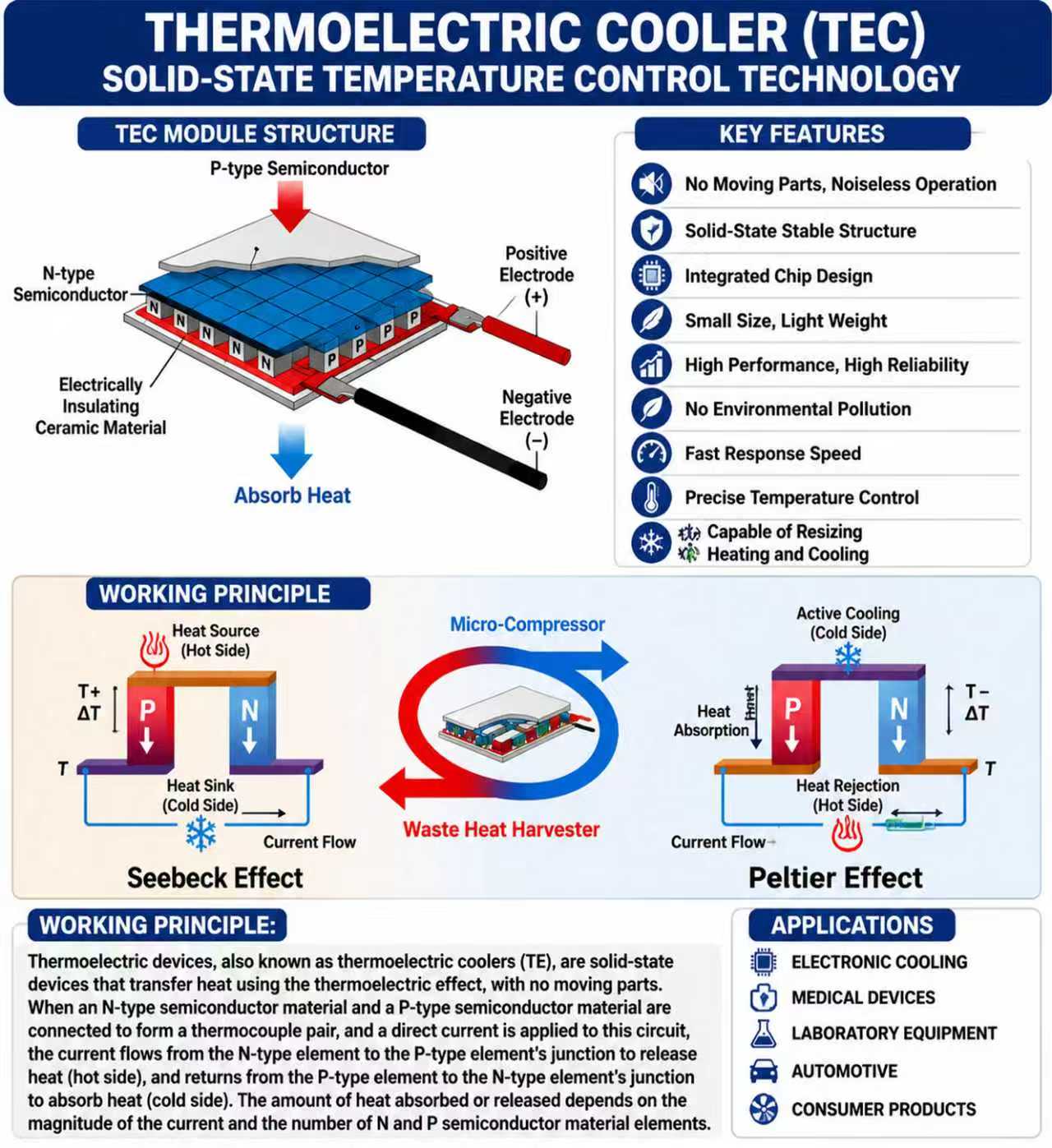
A thermoelectric cooler (TEC) is a solid-state heat-pumping device that uses the Peltier effect to transfer heat from one side of the module to the other when DC electrical power is applied.
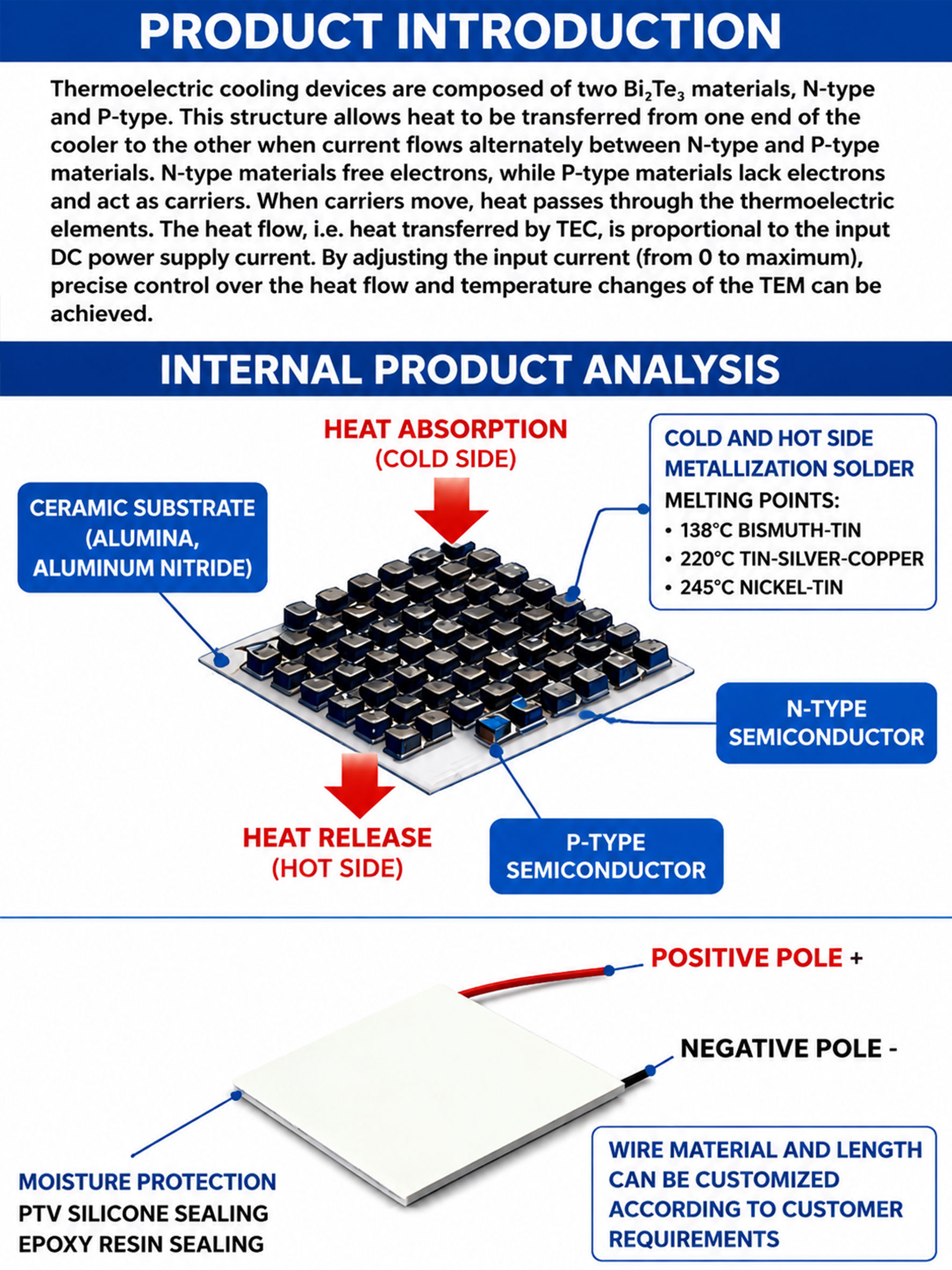
A typical TEC consists of multiple pairs of P-type and N-type semiconductor elements electrically connected between ceramic substrates. When DC current flows through the semiconductor couples, heat is absorbed on one ceramic surface and released on the opposite surface.
This creates a cold side and a hot side, allowing the TEC to provide localized cooling and precise temperature control.
By reversing the direction of the DC current, the hot and cold sides can be switched, allowing the same TEC to provide both cooling and heating when properly designed into a system. KKG products include standard TEC modules as well as micro, multi-stage and special-shaped thermoelectric cooling solutions.
Thermoelectric Cooling in Simple Terms
DC Power → Peltier Effect → Heat Transfer → Cold Side + Hot Side
Unlike compressor-based refrigeration, a TEC has no compressor, refrigerant or moving mechanical parts. This makes thermoelectric cooling particularly useful where compact size, precise temperature control, low vibration and reliable solid-state operation are required.
![]()
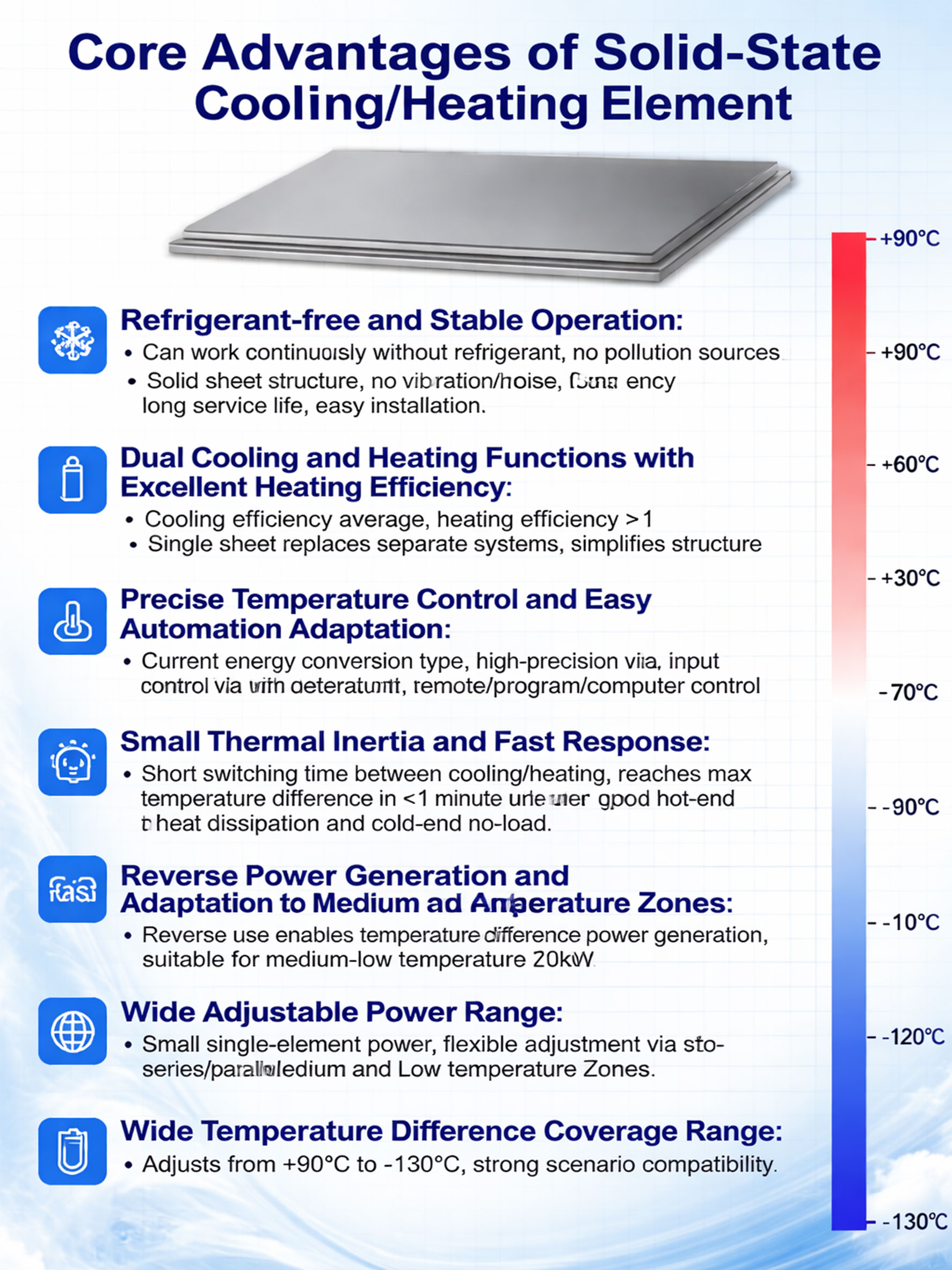
2. Thermoelectric Cooler Advantages
Thermoelectric cooling provides several advantages for precision thermal management.
Compact and Lightweight
A TEC is a compact solid-state component with no compressor or refrigerant circuit. Miniature KKG TEC products can be used where installation space is highly limited, while larger modules provide higher cooling capacity.
Precise Temperature Control
Cooling output can be controlled by adjusting the electrical operating conditions. With appropriate temperature sensing and control electronics, TEC modules can be integrated into automatic temperature-control systems.
Cooling and Heating
Reversing the DC current direction switches the hot and cold sides, allowing a properly designed TEC system to perform both cooling and heating.
Fast Thermal Response
Thermoelectric modules have low thermal inertia compared with many conventional refrigeration systems and can respond rapidly to changes in electrical input and thermal load.
No Refrigerant
TEC modules use solid-state semiconductor technology rather than conventional refrigerants, making them suitable for compact electronic and precision temperature-control systems.
Low Vibration and Low Noise
Because there are no compressors, motors or other moving mechanical components inside the TEC itself, thermoelectric cooling generates very little mechanical vibration or operating noise.
Flexible Product Design
TEC performance can be customized through semiconductor configuration, module size, number of stages, substrate material, shape, electrical parameters and other construction features.
![]()
3. Thermoelectric Cooler Applications
Thermoelectric cooling can be used wherever localized, compact and controllable temperature management is required.
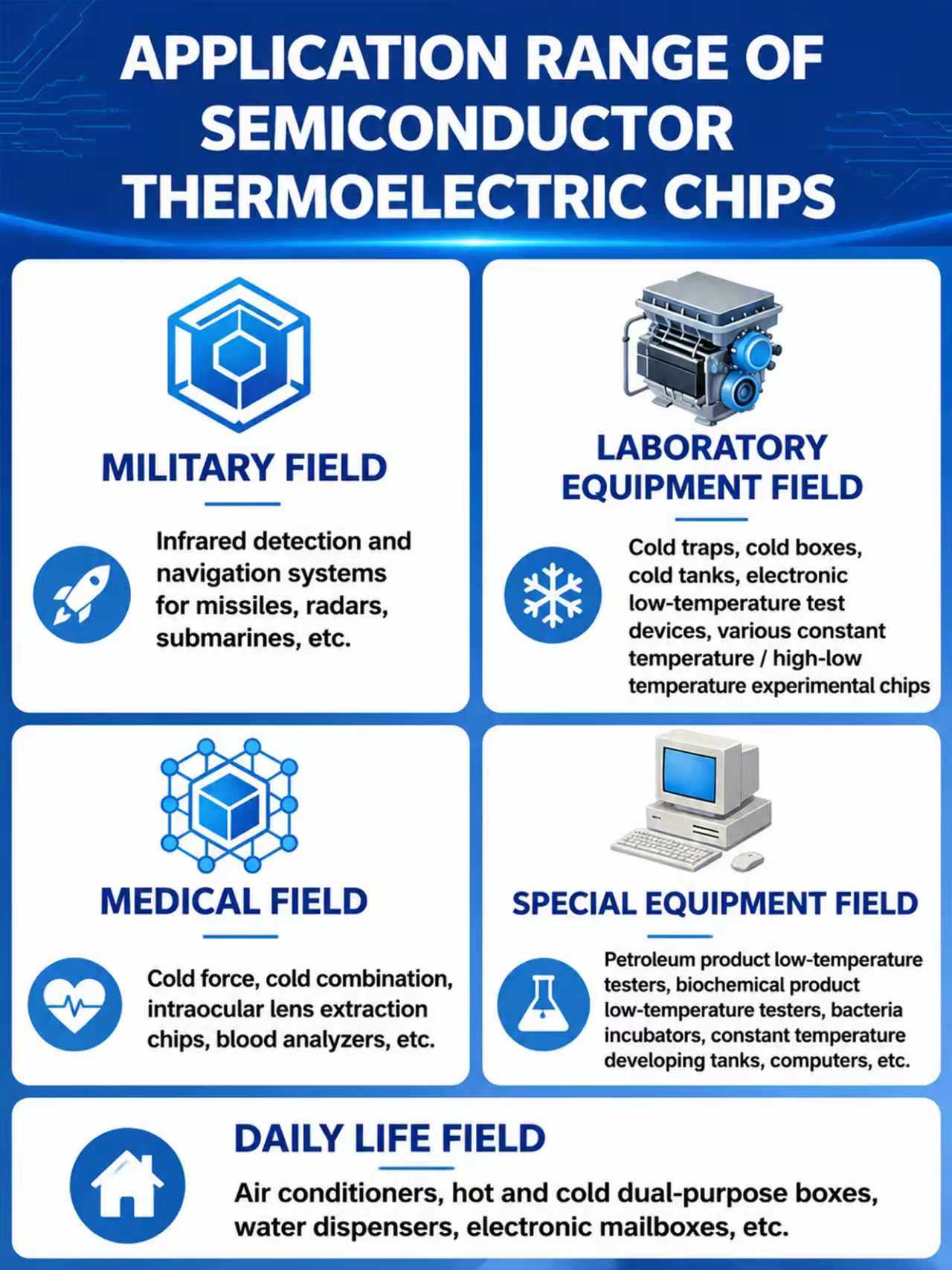
KKG's current product and application structure covers areas including AI and industrial equipment, optical communication, aerospace, automotive electronics, consumer electronics, medical equipment, LED and lighting, home appliances, and other specialized systems.
Optical Communication
TEC modules can provide precise temperature control for optical communication components where stable operating temperatures are important.
Laser Cooling
Thermoelectric coolers can be used for temperature stabilization and thermal management of laser and optoelectronic components.
Medical Equipment
Compact TEC modules are suitable for temperature-controlled medical instruments, analytical equipment and portable devices.
Industrial Equipment
TEC modules can provide localized cooling or heating for sensors, control electronics, instrumentation and other industrial equipment.
Automotive Electronics
Compact thermoelectric modules can be integrated into automotive electronic systems where space, reliability and controlled temperature are important.
Consumer Electronics
Miniature TECs can provide localized cooling for portable electronics, compact cooling devices and other consumer products.
Aerospace and Specialized Equipment
Thermoelectric technology is useful in applications requiring compact, solid-state temperature control under demanding environmental conditions.
AI and Advanced Electronics
As electronic systems become more compact and thermally demanding, localized thermoelectric cooling can provide targeted temperature management for specific components and assemblies.
![]()
4. Thermoelectric Cooler Structure
A conventional TEC module is built from several key components:
P-Type and N-Type Semiconductor Elements
The semiconductor couples form the core of the thermoelectric device. KKG's product information identifies bismuth telluride-based materials as the primary thermoelectric material system.
Ceramic Substrates
Ceramic plates provide electrical insulation, mechanical support and a thermal path between the thermoelectric elements and the external system.
Common substrate options include:
▪ Alumina ceramic
▪ Aluminum nitride ceramic
▪ Aluminum substrate for selected applications
KKG's current product structure includes alumina, aluminum nitride and aluminum substrate options.
Metal Electrodes
Metal electrodes electrically connect the thermoelectric elements and provide the electrical path through the module.
Soldering and Encapsulation
The semiconductor elements and electrical connections are assembled using appropriate soldering and sealing materials to create a stable thermoelectric module.
Basic TEC Structure
Ceramic Substrate→Metal Electrode→P-Type / N-Type Semiconductor Couples→Metal Electrode→Ceramic Substrate
The exact construction varies according to the module's size, electrical requirements, temperature range, substrate material and application.
5. Thermoelectric Cooler Working Principle
The operating principle of a TEC is based on the Peltier effect.
When DC current passes through a series of P-type and N-type semiconductor couples, heat is absorbed at one side of the module and transferred toward the opposite side.
Cooling Mode
Electrical Energy → Heat Pumping → Cold Side Absorbs Heat → Hot Side Releases Heat
The cold side is connected to the component or area that needs to be cooled, while the hot side must be connected to an appropriate heat dissipation system.
Heating Mode
When the polarity of the DC power supply is reversed, the direction of heat transfer changes. The former cold side becomes the hot side and the former hot side becomes the cold side.
Why Hot-Side Heat Dissipation Matters
A TEC does not simply "create cold." It moves heat.
The heat removed from the cold side, together with the electrical power supplied to the TEC, must ultimately be dissipated from the hot side.
Therefore:The hot-side heat sink is a critical part of the thermoelectric cooling system.
If the hot side cannot effectively dissipate heat, the temperature of the hot side will rise and the available cooling performance will decrease.
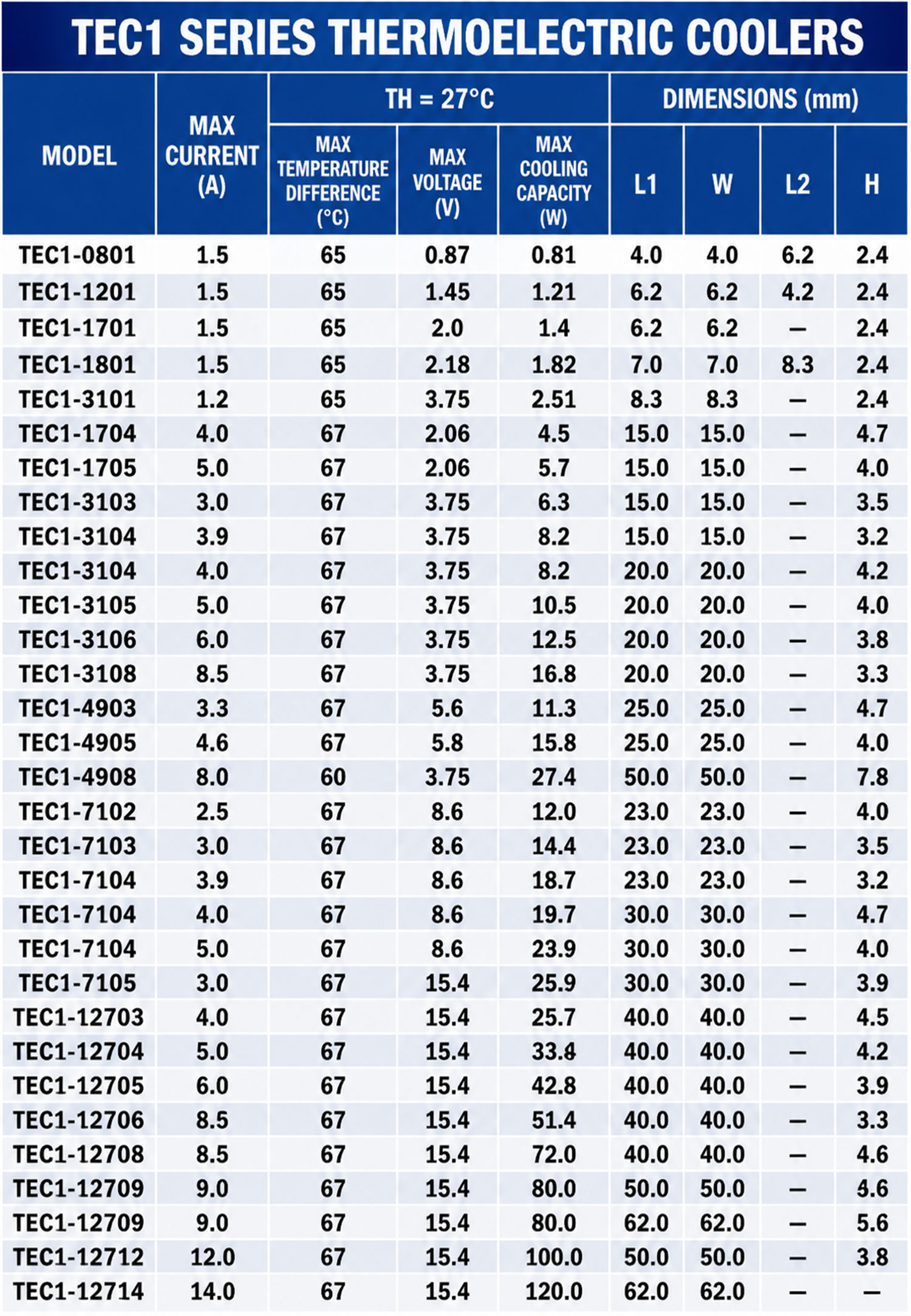
KKG product specifications commonly provide electrical and thermal parameters such as ΔTmax, Umax, Imax, resistance and Pmax to help engineers evaluate TEC performance.
6. Thermoelectric Cooler Parameters
![]()
7. Thermoelectric Cooler Materials
| Component Name | Consumer Grade Standard Material | Industrial Grade/High Power Standard Material |
|---|
| P-type/N-type Thermoelectric Legs | Bismuth Telluride-based Solid Solution (P-type: Bi₂Te₃-Sb₂Te₃; N-type: Bi₂Te₃-Bi₂Se₃) | High Purity Bismuth Telluride-based Solid Solution (Precise doping, low internal resistance) |
| Ceramic Substrate | Alumina Ceramic (Al₂O₃, Thermal Conductivity ≥ 20W/m·K) | Aluminum Nitride Ceramic (AlN, Thermal Conductivity ≥ 180W/m·K) |
| Metal Electrode | Purple Copper + Nickel Coating (Ni) | Purple Copper + Nickel-Gold Coating (Ni/Au) |
| Welding Layer | Tin-Bismuth Alloy Solder (Low melting point, easy to solder) | High Reliability Tin-Bismuth Alloy/Silver-based Solder (High temperature resistance) |
| Encapsulation Frame/Seal | Epoxy Resin/Silicone Rubber | High Temperature Resistant Epoxy Resin/Polyimide (PI) |
| Overall Encapsulation/Thermoelectric Pile Assembly | - (No separate material, includes combination of components) | - (No separate material, includes combination of components) |
8. Types of Thermoelectric Coolers
![]()
9. Thermoelectric Cooler Testing & Quality Inspection
Reliable TEC performance depends not only on semiconductor materials and module design, but also on consistent manufacturing and inspection.
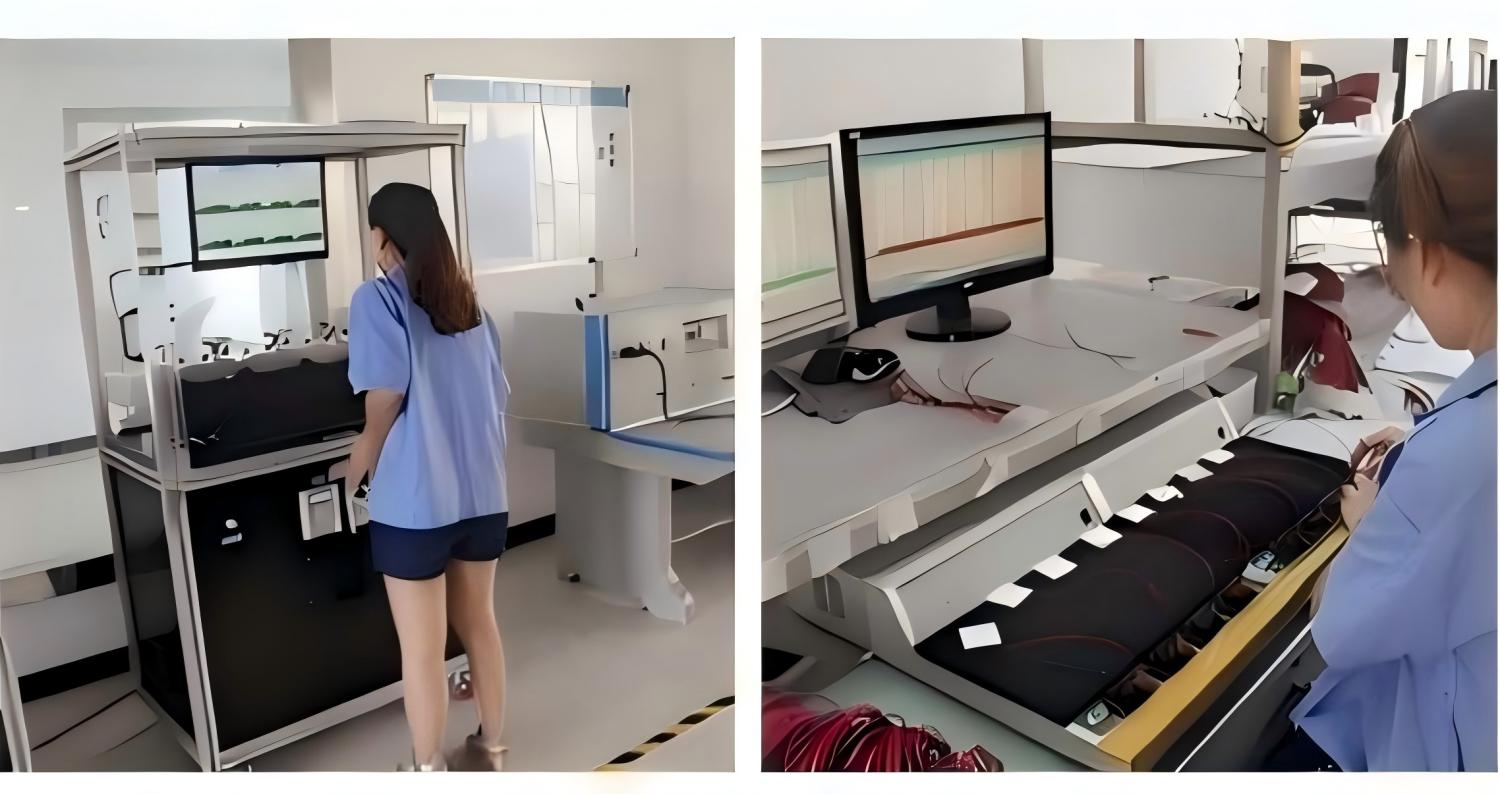
KKG's product knowledge center describes both automatic and manual inspection methods for thermoelectric cooling modules. Inspection can include appearance, electrical performance and cooling functionality.
Appearance Inspection
Visual inspection is used to check:
- Ceramic substrate condition
- Surface defects
- Edge condition
- Soldering appearance
- Wire and connection condition
- Sealing condition
Electrical Testing
Electrical performance can be evaluated using appropriate measurement equipment to check parameters such as:
- Electrical resistance
- Voltage
- Current
- Electrical continuity
Cooling Performance Testing
The module can be powered under controlled conditions to verify its cooling response and functional operation.
Automatic Inspection
For mass production, automated inspection can improve testing efficiency and consistency, while manual re-inspection can be used for verification and quality control.
KKG states that production-stage sampling inspections are combined with finished-product automatic and manual inspection processes to support product consistency.
![]()
How to Choose the Right Thermoelectric Cooler
Selecting a TEC should not be based on size or maximum temperature difference alone.
The following factors should be considered:
1. Required Cooling Capacity
Determine how much heat needs to be removed from the target component.
2. Required Temperature Difference
Determine the required cold-side temperature and expected hot-side temperature.
3. Hot-Side Heat Dissipation
Select an appropriate heat sink, fan, liquid cooling system or other heat dissipation method.
4. Operating Voltage and Current
The TEC must be compatible with the available power supply and control system.
5. Module Size
Select the module size according to the available installation space and thermal contact area.
6. TEC Structure
Choose between:
- Single-stage
- Multi-stage
- Micro TEC
- Custom-shaped TEC
according to the application's temperature and space requirements.
7. Substrate Material
Select alumina, aluminum nitride or other substrate configurations according to thermal, electrical and mechanical requirements.
8. Application Environment
Consider ambient temperature, hot-side temperature, humidity, vibration, installation conditions and expected operating life.
The right TEC is not necessarily the module with the highest ΔTmax or the highest power. It is the module whose electrical and thermal characteristics match the complete system.
KKG Thermoelectric Cooling Solutions
KKG provides a broad range of thermoelectric products covering standard TEC modules, micro thermoelectric coolers, multi-stage TECs, custom-shaped modules and application-specific thermoelectric solutions.
With more than 10 years of R&D and production experience and a product portfolio of more than 500 products, KKG supports both standard products and customized thermoelectric solutions.
Our TEC products are available in different:
Sizes · Cooling Capacities · Temperature Differences · Electrical Parameters · Structures · Materials · Shapes
Whether you need a compact 15×15 mm TEC, a standard 40×40 mm Peltier module, a multi-stage thermoelectric cooler, a ring-shaped module, or a customized thermoelectric cooling solution, KKG can provide products matched to your thermal management requirements.
Explore KKG Thermoelectric Cooler Products
Standard TEC Modules
Micro TEC Modules
Multi-Stage TEC Modules
Custom-Shaped TECs
High-Power Thermoelectric Coolers
Application-Specific Thermoelectric Solutions
Need help selecting a TEC? Contact KKG with your required cooling capacity, target temperature, hot-side temperature, available voltage/current and installation dimensions.