





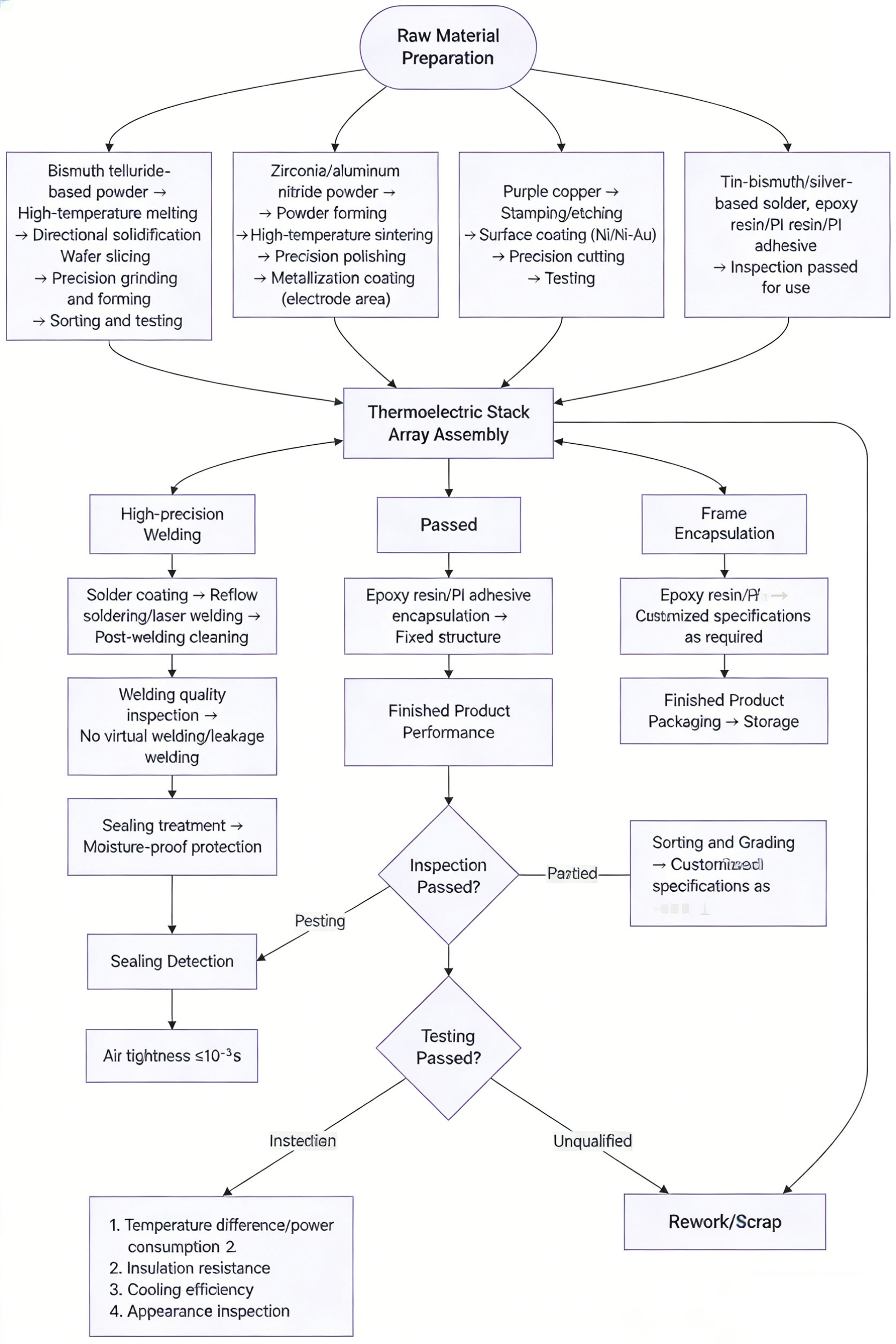
The materials and processing techniques of each part

ComponentConsumer MaterialIndustrial MaterialFunctionProcessCapability
P/N Thermoelectric LegsBi₂Te₃ solid solution (P/N formulas)High-purity Bi₂Te₃ (precise doping, low R)Heat exchange via carriersSmelt→Solidify→Slice→Grind→Sort±0.01mm cut, ≥95% ZT consistency
Ceramic SubstrateAl₂O₃ (≥20W/m·K)AlN (≥180W/m·K)Insulate/conduct heatMold→Sinter→Grind→Plate≤0.005mm flatness, ≥2000V voltage
Metal ElectrodeCu+NiCu+Ni/AuConnect P/N legsStamp→Plate→Cut±0.02mm, ≤5mΩ contact R
Welding LayerSn-Bi solder (low Tm)Sn-Bi/Ag solder (high T)Bond/low R heatCoat→Weld→Clean±0.01mm pos, ≤0.01% cold solder
Seal FrameEpoxy/siliconeHigh-T epoxy/PISeal/moisture-proofFrame encapsulation≤10⁻³Pa·m³/s air tightness
Pile Assembly- (integrated)- (integrated)Stabilize structureSort→Assemble→Test1-127 pairs, ΔT≥65℃, ≥100MΩ insulation


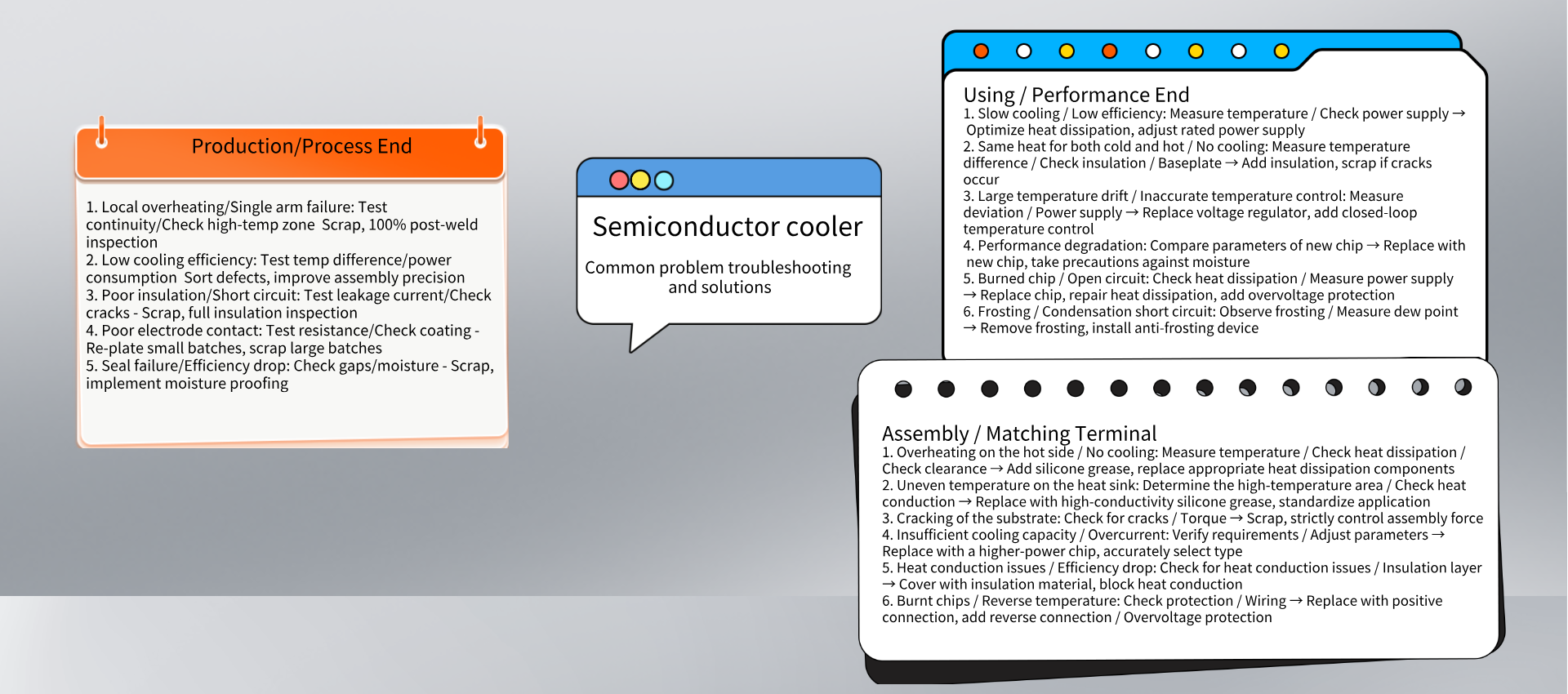
Common problems of semiconductor cooling sheets and their corresponding solutions

A.Production/process end

Local heating/single arm not working: measure continuity/set high temperature zone → scrap, fully inspected after welding

Low refrigeration efficiency: measuring temperature difference/power consumption → sorting defective products to improve assembly accuracy

Poor insulation/short circuit: leakage current measurement/crack detection → scrap, full insulation inspection

Poor electrode contact: resistance measurement/coating observation → small batch re plating, large batch scrap

Sealing failure/attenuation: check for gaps/moisture → scrap, moisture-proof throughout the entire process

B.Usage/Performance End

Slow cooling/low efficiency: temperature measurement/power supply check → optimize heat dissipation, adjust rated power supply

Same heat for hot and cold/no cooling: measure temperature difference/check insulation/substrate → repair insulation, crack scrap

Large temperature drift/inaccurate temperature control: measuring deviation/power supply → changing voltage regulator, adding closed-loop temperature control

Performance degradation: Compare new film parameters → Replace with new film and ensure moisture resistance

Burn/open circuit: check heat dissipation/test power supply → replace chip to repair heat dissipation, add overvoltage protection

Frost/condensation short circuit: observe frost/measure dew point → clear condensation, install anti condensation device

C.Assembly/matching end

Hot side overheating/no cooling: temperature measurement/check heat dissipation/gap → add silicone grease, replace with suitable heat dissipation components

Uneven temperature of heat sink: set high temperature zone/check thermal conductivity → replace with high thermal conductivity silicone grease and apply it in a standardized manner

Substrate cracking: Check for cracks/torque → scrap, strictly control assembly strength

Insufficient cooling capacity/overcurrent: nuclear demand/parameter adjustment → replace high-power chips, precise selection

Cross heating/efficiency reduction: Check cross heating/insulation layer → package insulation material to block cross heating

Burn/reverse hot/cold: check protection/wiring → replace the chip with positive, add reverse/overvoltage protection

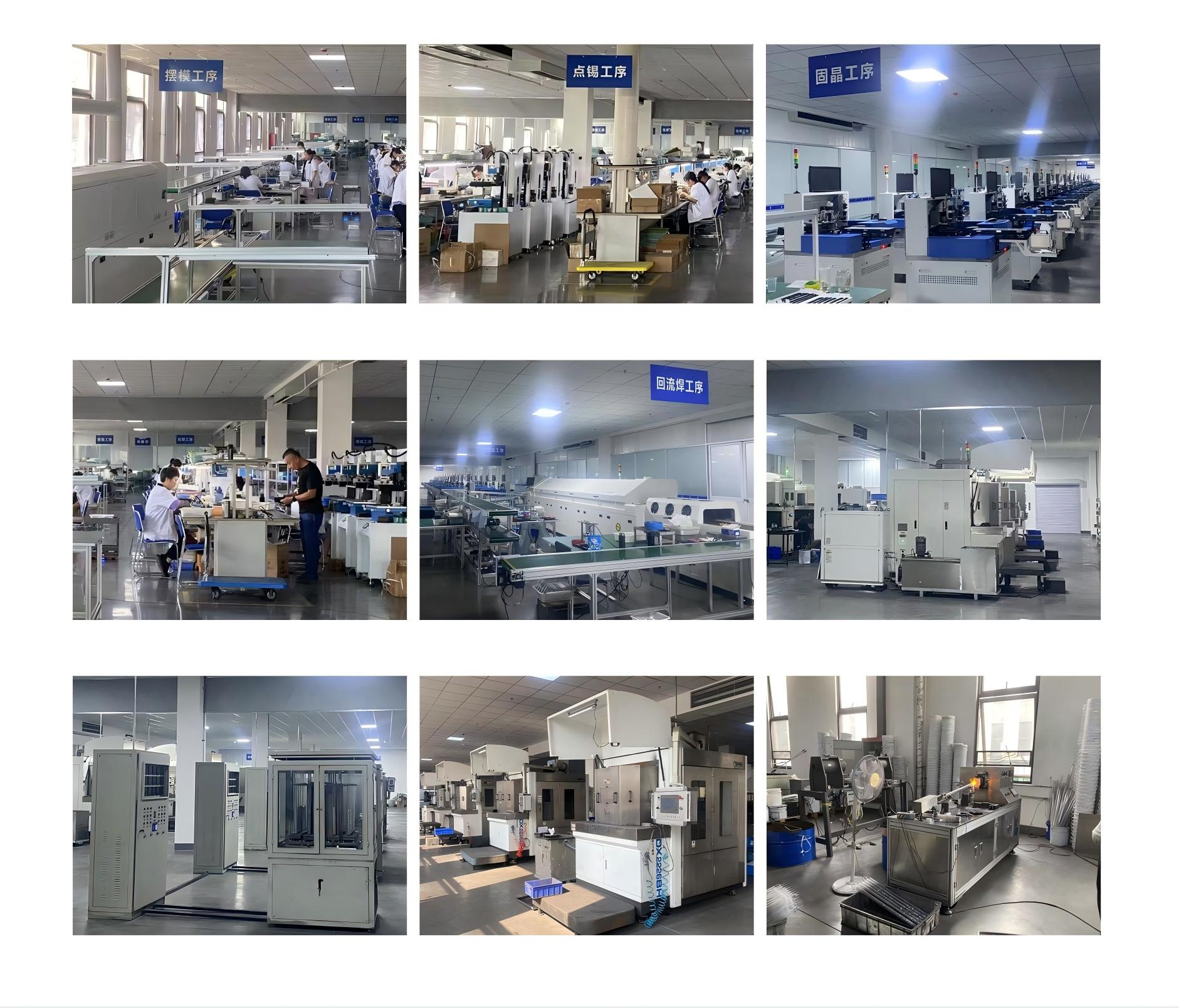
Production process

1. Raw material preparation: Bismuth telluride is the main material, with antimony/seelenium as the dopant. Combined with the specified substrate and copper conductor, it is processed through vacuum melting and directional solidification to produce N/P type ingots; the substrate and the flow guide component are clean and free of impurities, and the flow guide component is protected against oxidation. 2. Steel ingot processing: N/P type steel ingots undergo annealing to relieve internal stress, are precisely cut into standard grains, and unqualified products are screened out. 3. Substrate metallization: The ceramic substrate is equipped with copper/nickel/gold electrodes. Low-melting-point solder paste is applied through sputtering/electroplating to form multi-layer electrodes. High-precision printing is employed, ensuring no missed or false printing of the pads. 4. PN crystal grain arrangement: The automated equipment arranges N/P type crystals alternately on the substrate with solder pads, forming a thermoelectric stack array with precise positioning without any offset. 5. Reflow Soldering: The upper and lower substrates are welded to form a crystal array. The temperature is controlled in two stages for curing to prevent damage; after soldering, ultrasonic cleaning is used to remove residues, and hot air drying is performed. 6. Terminal Outlets: Ultrasonic/laser welding of wires to positive/negative connection terminals to ensure good conductivity and no false soldering. 7. Packaging protection: Apply heat-resistant glue to the edges and connection points to enhance protection; Mark the model, specifications, and production date with inkjet printing. 8. Finished product inspection: Test the cooling capacity, temperature difference, and insulation resistance. After undergoing cold and hot cycle/vibration tests, qualified products will be packaged with anti-static and moisture-proof measures and then stored in the warehouse

0
Inquire for more cooperation or product information.
We will contact you within 1 working day, please check your email.
Name
Mail
Mobile phone
Message
Send

NewSite

We reply immediately
Welcome to our website. Ask us anything 🎉

Start Chat with: