





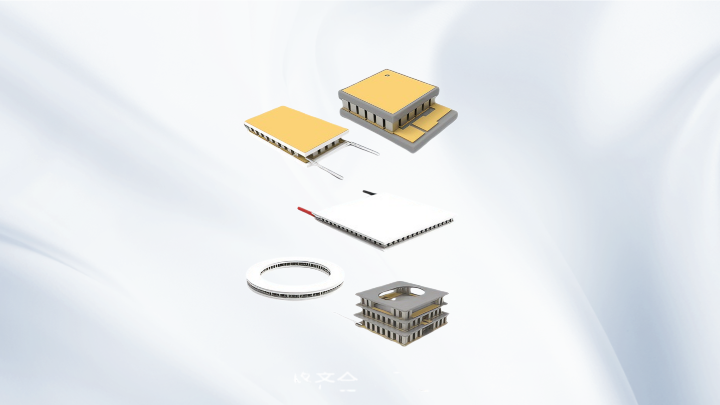
The Ultimate Guide to KKG Thermoelectric Coolers: Efficiency and Innovationthermoelectric cooler
This article provides a detailed introduction to the principles, characteristics, applications and practical operation points of thermoelectric coolers, serving as a reference for technical selection and on-site operation.
What is KKG Thermoelectric Cooler?
The KKG thermoelectric cooler (TEC) is a solid-state semiconductor thermal control component based on the Peltier thermoelectric effect. When DC current flows through its doped semiconductor couples, directional heat migration occurs: one end absorbs heat while the other dissipates heat, realizing active cooling or heating without phase change or mechanical compression.
Compared with vapor-compression refrigeration systems that dominate traditional cooling fields, KKG TECs eliminate mechanical moving parts and chemical refrigerants. This design brings intrinsic advantages including high operational reliability, compact form factor, vibration-free operation and zero refrigerant pollution. These properties make it irreplaceable in high-precision thermal control fields where stability and environmental compliance are strictly required, covering medical analytical instruments, industrial laser equipment and precision electronic packaging cooling.
Core Strengths & Technical Characteristics
Constructed with high-strength ceramic substrates and reliable semiconductor chips, KKG TECs feature fast thermal response and flexible temperature adjustment, supporting rapid heating and cooling cycles. The elimination of compressors and circulating refrigerants cuts down mechanical failure risks and regular maintenance workload, and ultra-low operating noise also adapts to laboratory, medical and aerospace-grade quiet working environments.
The core technical advantage of KKG TEC lies in high-precision closed-loop temperature control. It can maintain temperature fluctuation within a minimal range for long-duration operation, which is the fundamental guarantee for repeatable experiments and continuous industrial production. It should be clearly defined that thermoelectric cooling is a localized thermal control solution, and its technical advantages cannot be extended to large-volume space cooling scenarios.
TEC Products' Industrial Application
The combination of miniaturization, low noise and precise temperature control enables KKG TECs to solve differentiated thermal problems across multiple industries.
In medical and biotech fields, portable TEC cooling units maintain a constant low-temperature environment for cold-chain transportation of vaccines and biological reagents, protecting biological activity. Inside PCR thermal cyclers, TECs undertake high-frequency rapid temperature switching, which is the core condition to complete nucleic acid amplification.
In the electronics industry, high-density power devices such as CPUs, laser diodes and infrared photodetectors generate concentrated local heat flux. Targeted cooling by KKG TECs effectively suppresses hot spots and avoids thermal drift or permanent damage of precision components.
In the automotive industry, TEC technology is applied to passenger seat cooling and new energy vehicle battery thermal management. Limited in-vehicle installation space and strict vehicle-level power consumption standards make the small size and low power consumption of KKG TECs key technical advantages for vehicle-mounted thermal systems.
Performance, Efficiency & Selection Principles
Coefficient of Performance (COP) and maximum temperature difference (ΔT) are two core indicators for evaluating TEC comprehensive performance. Restricted by the physical properties of semiconductor materials, KKG TECs reach the optimal energy efficiency when the cold-hot side temperature difference is between 20°C and 40°C. As ΔT increases, the internal heat backflow of the module intensifies, leading to a continuous decline in COP.
Perfect heat dissipation and systematic thermal design are the prerequisites for TEC to operate at rated parameters. KKG provides a complete product matrix including different sizes, power levels and structural forms to adapt to diverse heat load demands. In engineering selection, designers need to calculate the total heat load of the system first, and match the TEC capacity reasonably. Excessive margin will increase system power consumption and cost, while insufficient capacity will cause thermal runaway risk.
Installation Specifications & Engineering Best Practices of TEC Cooler
The assembly structure directly determines the contact thermal resistance of the whole system. The KKG TEC must be clamped between the heat source and heat sink with uniform pressure. Thermal interface materials such as thermal grease and thermal gaskets are mandatory to fill contact gaps and reduce interfacial thermal resistance.
Electrical polarity is a fatal factor for normal operation. Reversing the input current will swap the cold and hot surfaces, resulting in complete functional failure. Long-term operation will cause dust and foreign matter to accumulate on heat sinks and fans, blocking heat dissipation channels. Periodic cleaning is a standard maintenance procedure to sustain long-term stable performance.
For high-power applications with high heat flux, conventional forced air cooling cannot meet heat dissipation requirements. Matching TEC with liquid cooling systems is an optimized solution to improve heat exchange efficiency and reduce the comprehensive thermal load of modules.
FAQ of TEC Product
1.What is the service life of KKG thermoelectric coolers?
With no moving mechanical parts, the nominal service life exceeds 200,000 hours under steady-state constant temperature operation. Nevertheless, frequent thermal cycling and sustained high ambient temperature will induce semiconductor thermal fatigue and internal material aging, which will accelerate performance attenuation and shorten the actual service life significantly.
2.Can thermoelectric coolers be used for room cooling?
Technically infeasible. TEC is designed for local concentrated heat dissipation rather than large-space refrigeration. Its efficiency drops sharply under large temperature differences, resulting in extremely high energy consumption and poor practical value for indoor cooling.
3.Is the thermoelectric module reversible for heating?
Yes. The Peltier effect is bidirectional; reversing the current direction switches the cooling function to heating. However, TEC is not optimized for heating scenarios, so its thermal efficiency is much lower than dedicated resistive heating elements.
4.What is the maximum achievable temperature difference?
Standard single-stage KKG thermoelectric modules can reach a maximum ΔT of around 70°C. For applications requiring ultra-large temperature differences, multi-stage cascaded modules are adopted. Such structures can achieve higher temperature spans, but accompanied by further reduced overall energy efficiency.
