





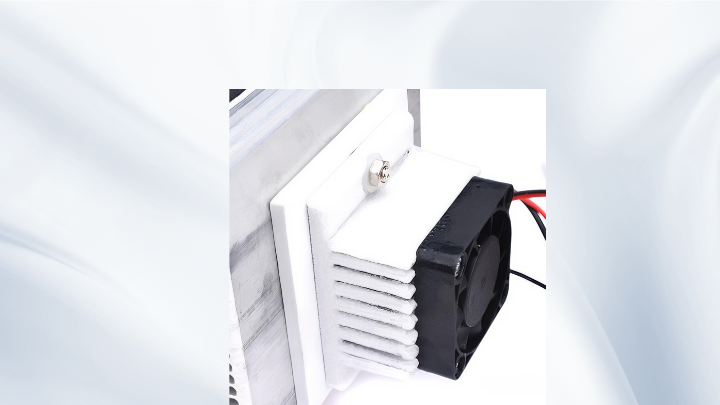
Thermoelectric Coolers: Technical Analysis, Performance Advantages and Engineering Selection Guide
🔷1. Principles and Technical Characteristics of Thermoelectric Cooling Technology
Thermoelectric cooling operates based on the Peltier effect. When direct current passes through thermocouples composed of N-type and P-type semiconductor thermoelectric legs, directional carrier energy migration creates a targeted heat flow across the device. One end absorbs heat for cooling while the other continuously dissipates heat, realizing heat transfer without working fluids.
As a typical solid-state cooling technology, it eliminates compressors, transmission mechanisms and other moving parts, delivering inherently low vibration and low noise operation. It also features fast temperature response and high linear regulation, enabling precise temperature control. This makes it a mainstream cooling solution for high-end scenarios such as precision electromechanical and optoelectronic instruments.
KKG adopts bismuth-telluride based thermoelectric semiconductors, which deliver optimal comprehensive performance for commercial cooling applications. By optimizing material composition and packaging processes, we enhance the thermoelectric figure of merit and long-term operational stability, making the products well-suited for industrial scenarios requiring continuous operation and heavy-duty performance.
🔷2. Substrate Selection and Structural Design of TEC Cooler: Building an Efficient Heat Transfer System
The substrate acts as the core heat transfer carrier of thermoelectric coolers. To meet diverse requirements for thermal conductivity, electrical insulation and cost across operating conditions, KKG provides four mainstream thermally conductive substrates: aluminum plate, copper plate, alumina ceramic substrate and aluminum nitride ceramic substrate.
Both alumina and aluminum nitride ceramic substrates undergo surface metallization before delivery. This process retains the ceramics’ superior insulation and thermal shock resistance while resolving poor solderability, enabling reliable bonding between thermoelectric chips and substrates. Combined with support structures optimized via thermal and mechanical simulation, a low-thermal-resistance heat transfer channel is constructed to maximize heat conduction and dissipation efficiency.
All finished units undergo stringent factory inspections, including long-term thermal cycle aging tests and full-range electrical insulation withstand tests, to eliminate early failure risks at the process stage. Benefiting from sophisticated structural design and strict quality control, the product achieves a steady-state temperature control accuracy of ±0.1°C, maintaining a stable temperature field even under dynamic load disturbances.
This level of temperature regulation is critical to the stable operation of laser emitters, PCR thermal cyclers, infrared detector arrays and other precision equipment. It effectively suppresses the adverse impacts of temperature drift on optical accuracy, test data and component service life.
🔷3. Energy Efficiency and Environmental Benefits of TEC Product
Compared with traditional vapor compression refrigeration systems, high-performance thermoelectric coolers can reduce overall energy consumption by up to 30% when equipped with a closed-loop precision temperature control strategy.
In terms of device design, KKG applies welding technology with low contact resistance alongside materials with a high thermoelectric figure of merit (ZT). This reduces Joule heat loss from both material and structural perspectives, further improving energy conversion efficiency.
From an environmental perspective, this series of products uses no chemical refrigerants such as freon or hydrofluorocarbons. It poses no risks of refrigerant leakage or atmospheric pollution, fully complying with the prevailing trends of low-carbon emission reduction and green manufacturing in the industrial sector.
🔷4. Adaptability to Harsh Conditions and Service Life Analysis of Thermoelectric Cooler Peltier
For demanding operating environments featuring high humidity, drastic temperature fluctuations and complex mechanical stress, the product adopts dense ceramic cover plates and an integral hermetic packaging structure. This effectively blocks moisture penetration and mitigates structural deformation and delamination risks caused by cyclic thermal stress. The core thermoelectric legs are manufactured using the sintering process, which greatly enhances mechanical strength and slows performance degradation during long-term operation.
Essentially, thermoelectric coolers are fully solid-state devices with no moving friction components. The device itself will hardly suffer structural damage if installed properly, operated within rated parameters and paired with a well-matched heat dissipation system. Currently, the product’s proven Mean Time Between Failures (MTBF) exceeds 200,000 hours. Thanks to its exceptional reliability, it is widely deployed in aerospace systems, automotive perception units, military electronic equipment and other mission-critical fields where equipment failure is unacceptable.
🔷5. Product Portfolio and Customized Integration Solutions for Peltier Effect Cooler
KKG has built a comprehensive product portfolio covering a wide range of scenarios from industrial communications to wearable electronics. Standard modules are applicable to optical transceivers in data centers and communication base station components, while miniaturized cooling units can be integrated into portable wearable cooling devices. For applications requiring large temperature differences, we offer multi-stage series-connected cooling modules. Compact products are developed to fit confined installation spaces.
To meet the demands of complete machine integration, our team provides full-range customized development services. We can tailor overall dimensions, electrode specifications and mounting configurations according to customers’ equipment structures, enabling seamless integration with existing frameworks and reducing costs and workload for secondary development and structural modification.
🔷6. Technical Selection and Frequently Asked Questions
6.1 Core Guidelines for Thermoelectric Cooler Selection
Four key parameters shall be confirmed first for engineering selection: reserved installation dimensions, rated operating voltage and current, required cooling capacity (Qc) and maximum temperature difference (ΔT) of the application scenario.
We provide complete performance characteristic curves, mechanical dimension drawings and electrical parameter manuals to support preliminary selection. If standard products fail to meet special requirements for space, electrical indicators or extreme operating conditions, customers may contact our professional technical team for customized design and sample development.
6.2 Can the product cool below ambient temperature?
Yes. When paired with a high-performance heat dissipation system or multi-stage series-connected cooling modules, the device can achieve a maximum temperature reduction of 70°C below ambient temperature. It should be noted that thermoelectric cooling has an inherent characteristic: the Coefficient of Performance (COP) declines as the temperature difference between the hot and cold sides increases. Therefore, a multi-stage series architecture is recommended for large temperature difference applications to balance cooling capacity and operational energy efficiency.
6.3 Service Life of the Product
Without moving wear-prone parts, the service life of a thermoelectric cooler is mainly affected by four factors: installation method, heat dissipation conditions, ambient humidity and thermal cycle amplitude. Under rated low-load operating conditions with proper use, the product can operate stably for more than 200,000 hours.
In daily operation, optimizing heat dissipation design to prevent internal condensation and adopting dedicated controllers to suppress thermal cycles can further extend the service life of the device.
