





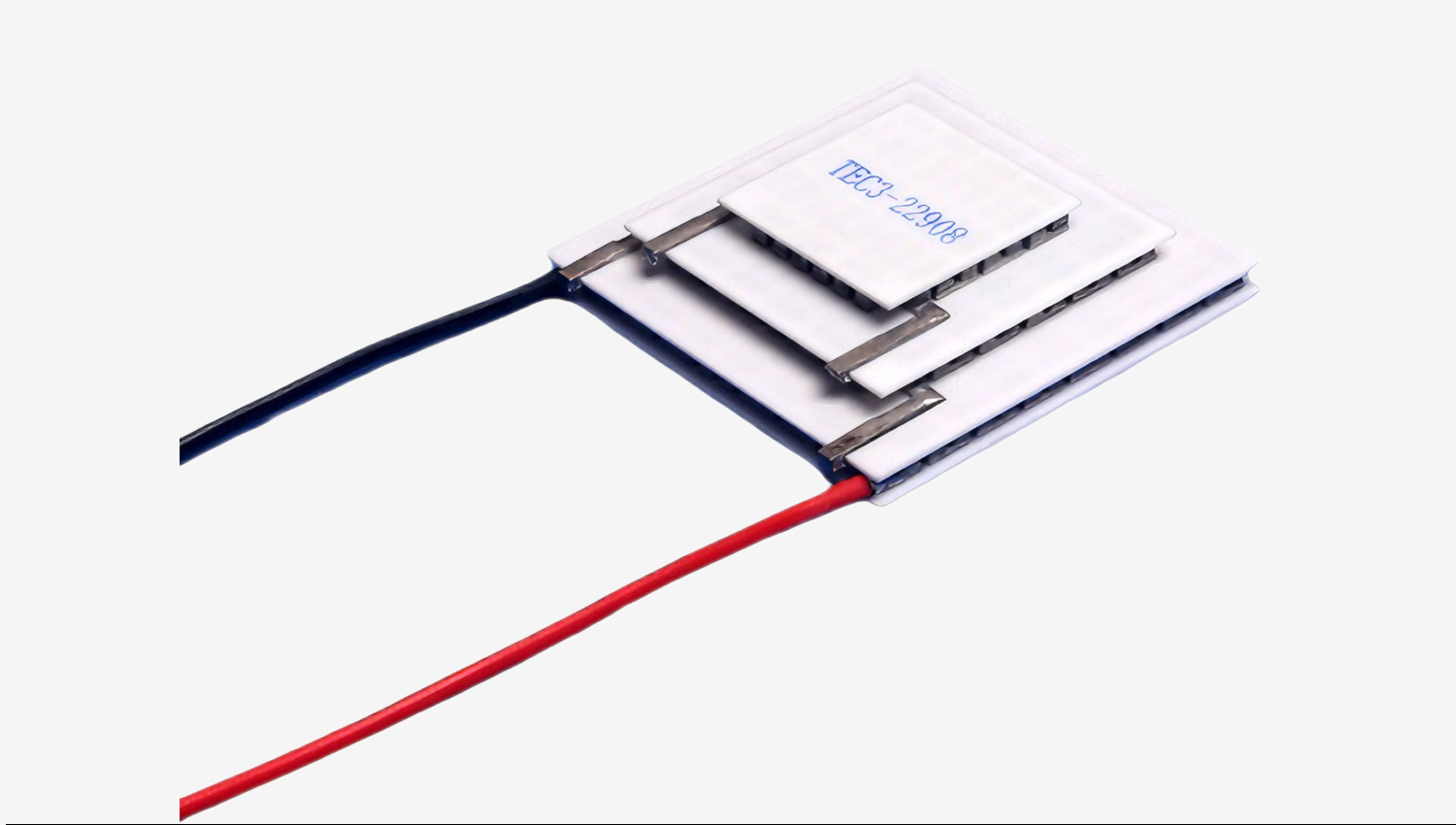
Comprehensive Introduction to Multi-stage Thermoelectric Coolers
Multi-stage thermoelectric coolers, also known as multi-level Peltier cooling modules, are advanced cascaded solid-state cooling devices developed on the basis of single-stage thermoelectric coolers. By stacking multiple sets of thermoelectric units along the axial direction, they break the maximum temperature difference limit of single-stage products and deliver deep cooling with large temperature differentials. Meanwhile, they retain the inherent advantages of solid-state cooling such as low noise, precise temperature control and high reliability, and are widely adopted in high-end precision equipment and special operating conditions. This article elaborates on their structural features, working principles, layered heat dissipation mechanism, core performance, application scenarios, installation guidelines and selection criteria in detail.
🔷1. Structural Features of Thermoelectric Generator
Multi-stage thermoelectric coolers adopt a cascaded layered structure with integrated hermetic packaging, consisting of two or more independent single-stage thermoelectric units connected in series along the heat flow direction. The overall structure is sophisticated and mechanically robust.
Each individual unit is a standard thermopile, composed of N-type and P-type bismuth-telluride thermoelectric semiconductor pellets, high-conductivity copper connectors and high-thermal-conductivity substrates. Four types of mainstream substrates are available: aluminum plate, copper plate, alumina ceramic substrate and aluminum nitride ceramic substrate. All ceramic substrates undergo surface metallization before delivery. This process improves solderability while maintaining excellent electrical insulation and thermal conductivity, catering to diverse requirements for heat dissipation, insulation and cost.
Between adjacent layers, low-thermal-resistance transition thermal layers and thermal isolation structures are installed. The thermal layers ensure efficient heat transfer between upper and lower units, while the isolation structures effectively suppress cross-layer thermal crosstalk and avoid mutual offset of cold and heat energy. The internal thermoelectric legs are fabricated via sintering technology, which delivers much higher mechanical strength than traditional welded structures. The whole module is fully sealed to prevent moisture and dust ingress. With no gears, fans, transmission mechanisms or other moving parts, mechanical wear is fundamentally eliminated.
Two circuit layouts are applied in practical products. Medium and low-power modules generally adopt series power supply, where all units share the same input voltage and current for simple control. For high-power and large-temperature-difference models, independent power supply for each stage is adopted, enabling separate power regulation to optimize overall energy efficiency.
🔷2. Working Principles of Peltier Cooler
The operation of multi-stage thermoelectric coolers is based on the Peltier effect, and its core working mode is relay-style heat transfer across stages to achieve far stronger cooling capacity than single-stage devices.
When direct current passes through thermocouples made of P-type and N-type semiconductors, charge carriers exchange energy at material interfaces. Heat is absorbed at the current inlet to form a cold end, while heat is released at the current outlet to form a hot end, realizing directional heat migration from the cold end to the hot end. Restricted by material properties, Joule heat and reverse heat conduction, the maximum temperature difference of conventional single-stage coolers is only 55~60°C, which cannot meet the demand for ultra-low temperature. The cascaded multi-stage design is proposed to solve this problem.
Multi-stage modules operate following the logic of pre-cooling stage by stage and progressive temperature reduction. The cold end of the innermost first-stage unit is in direct contact with the load to be cooled. It absorbs heat generated by the equipment and transfers all heat to its own hot end. The cold end of the second-stage unit closely attaches to the hot end of the first stage, providing forced pre-cooling and transporting accumulated heat outwards again. By analogy, each subsequent stage takes the hot end of the previous stage as its heat source and continuously transfers heat in a relay manner. Superposition of multiple layers greatly expands the overall temperature difference and realizes deep cooling.
All heat absorbed from the load and Joule heat generated during operation eventually converge to the hot end of the outermost final stage, which dissipates heat to the ambient environment via external heat dissipation components. It should be noted that the Coefficient of Performance (COP) of thermoelectric cooling decreases as the temperature difference between cold and hot ends increases. More stages mean higher accumulated Joule heat and larger reverse heat loss, leading to lower overall efficiency. For this reason, multi-stage thermoelectric coolers are mainly applied to scenarios requiring large temperature differences and low cooling capacity.
🔷3. Layered Heat Dissipation Mechanism
The heat flow direction runs opposite to the cooling direction of the stages. The overall heat dissipation follows the rule of conducting heat stage by stage and dissipating heat centrally at the terminal. Each layer plays a connecting role in heat transfer, and the interfacial thermal resistance is the key factor determining heat dissipation efficiency.
Heat absorption and transfer of the first stage: The cold end of the innermost unit absorbs heat from the target equipment. The absorbed heat, together with Joule heat produced by current conduction, is transmitted to the hot end of this stage.
Relay heat transfer of intermediate stages: Each intermediate unit receives heat from the hot end of the previous stage. With the help of low-resistance transition layers between stages, heat is steadily delivered to the next layer. Every stage relieves the heat pressure of the front unit and further lowers the temperature of the inner cold end. Meanwhile, thermal isolation structures restrain reverse heat backflow from high-temperature outer layers to low-temperature inner layers and prevent cooling performance degradation.
Central heat dissipation of the final stage: After being transferred through all layers, all heat gathers on the main heat dissipation substrate of the outermost stage. This substrate must be equipped with radiators, water cooling heads or forced air cooling systems to continuously exhaust residual heat to the surroundings.
Once heat accumulation occurs in any middle layer or the terminal heat dissipation system works inefficiently, heat will flow back to the front end, raising the cold end temperature and even causing module overload and failure. Therefore, layered process design and matched external heat dissipation systems are essential for stable operation.
🔷4. Core Product Characteristics of Peltier Module
Large temperature difference and ultra-high temperature control accuracy: The multi-stage structure enables a temperature drop of over 70°C below ambient temperature. The steady-state temperature control accuracy reaches ±0.1°C. The temperature field remains stable even under dynamic load fluctuations, fully meeting high-precision temperature control requirements.
High reliability and long service life: As an all-solid-state device with no moving parts, it is free from mechanical wear. With correct installation, matched operating conditions and sufficient heat dissipation, structural failure rarely occurs. Its Mean Time Between Failures (MTBF) exceeds 200,000 hours. The sealed structure enables stable operation in humid environments and under mild thermal stress.
Eco-friendly and quiet operation: No chemical refrigerants such as Freon or hydrofluorocarbons are used, so there is no greenhouse gas emission, complying with low-carbon and environmental protection standards. The device operates without vibration or noise and will not interfere with precision optical and detection equipment.
Flexible regulation: It features fast start-up and excellent linear temperature adjustment. The cooling power can be flexibly changed by adjusting input voltage and current to adapt to various temperature control strategies.
🔷5. Main Application Scenarios of TEC Cooler
Thanks to the combined advantages of large temperature difference, high precision and superior reliability, multi-stage thermoelectric coolers are primarily used in high-end precision manufacturing, laboratory research, aerospace, military electronics and other demanding fields:
Optoelectronic industry: High-power laser diodes, infrared focal plane detectors, night vision imaging devices and optical sensing systems;
Biological laboratories: PCR thermal cyclers, low-temperature sample storage devices and high-precision biochemical testing instruments;
Special equipment: On-board electronic systems for aerospace, special vehicle sensors and military low-temperature detection equipment;
Industrial precision testing: High-end on-line testing instruments and small low-temperature thermostatic equipment.
🔷6. Key Installation Notes of Thermoelectric Cooler Peltier
Installation quality directly affects cooling performance and service life. The main requirements are listed as follows:
Full contact and uniform compression: Ensure full surface contact between all substrates, the outer main substrate and heat dissipation components. Apply fastening pressure evenly. Partial stress is forbidden to avoid cracking of ceramic substrates and sharp increase of interfacial thermal resistance.
Moisture-proof and sealing treatment: Implement comprehensive sealing protection to block humid air from entering the module. Condensation inside will cause electrical short circuits and corrosion of thermoelectric components.
Standardized electrical operation: Power the device strictly in accordance with the rated voltage and current. Overload operation and instantaneous surge voltage are prohibited to prevent burnout of thermoelectric units.
High-performance matched heat dissipation: The outermost substrate must be fitted with qualified heat dissipation systems. Water cooling or forced air cooling is preferred for working conditions with large temperature differences to eliminate terminal heat accumulation.
Environment adaptation: Keep the module away from severe vibration and corrosive gas to protect the layered structure and outer sealing layer.
🔷7. Core Selection Criteria of Peltier Effect Cooler
The selection of multi-stage thermoelectric coolers requires comprehensive evaluation from four dimensions: structure, electrical performance, thermal performance and operating environment. Five core parameters must be confirmed:
Installation dimensions: First confirm the reserved internal space of the equipment, and match the overall size, thickness and lead position of the module. Extra space for installation and heat dissipation shall be reserved due to the stacked structure.
Electrical parameters: Clarify the rated operating voltage and current of the system to match the electrical specifications of the module. Select series power supply or independent staged power supply according to power rating and stage quantity.
Thermal parameters: Accurately calculate the required cooling capacity (Qc) and maximum operating temperature difference (ΔT) to determine the number of cooling stages and power grade of the module.
Substrate selection: Select aluminum plate, copper plate, alumina ceramic substrate or aluminum nitride ceramic substrate based on heat dissipation efficiency, electrical insulation level and budget.
Operating environment: Determine the sealing grade and structural reinforcement scheme according to on-site humidity, ambient temperature and vibration intensity.
If standard products cannot meet special requirements on size, shape, leads or installation methods, customized design is available to realize seamless integration between the module and the complete equipment.
