





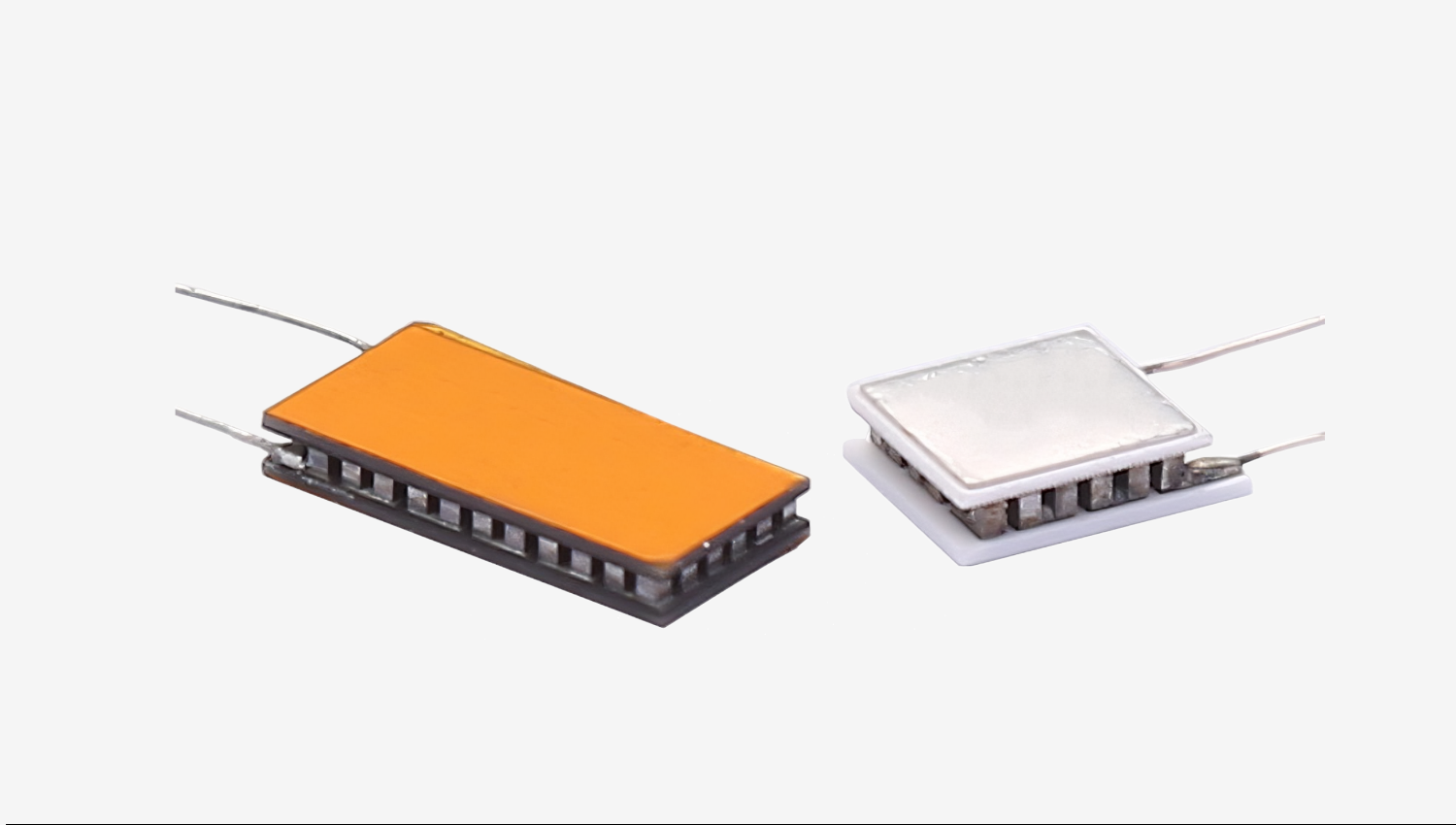
In-Depth Introduction to KKG Thermoelectric Coolers
1. Working Mechanism & Core Technology
KKG thermoelectric coolers are all-solid-state thermal control components that transfer heat bidirectionally via the semiconductor Peltier effect. Unlike conventional compressor-based refrigeration systems, these coolers eliminate all moving mechanical parts while featuring a compact, lightweight form factor, delivering exceptional operational reliability for applications with strict constraints on installation space and noise emission. Their core heat exchange units are fabricated from specialized semiconductor thermoelectric materials. A stable temperature gradient forms across the two sides of the module once energized. By simply reversing the power polarity, users can switch between cooling and heating modes to achieve high-precision bidirectional thermal regulation, catering to diverse constant and variable temperature demands across industrial and consumer fields.
2. Core Advantages of Adopting KKG Thermoelectric Coolers
Instant thermal response stands out as one of KKG modules’ most distinctive competitive edges. The devices reach precise target temperatures within mere seconds without lengthy startup or stabilization delays—a critical feature for laser diode temperature stabilization, DNA amplification in PCR instruments, and thermal management of industrial precision electronics.
Furthermore, the solid-state architecture requires no refrigerants or compressors, fundamentally eliminating environmental hazards from refrigerant leakage and pipeline degradation while cutting full-lifecycle maintenance expenses. The wear-free semiconductor structure enables an extended service life exceeding 100,000 hours under standard operating conditions, making the coolers ideal for non-stop 24/7 continuous operation.
3. Thermal Management Applications for Electronic Equipment
Within the electronics industry, KKG thermoelectric coolers are widely integrated into active heat dissipation systems for high-power LED lighting, industrial processors, and optical communication base station components. Their efficient, controllable heat transfer suppresses power degradation and operational drift induced by temperature rises, effectively extending the service life of core electronic parts.
Take fiber-optic communication systems as an example: laser diodes are extremely sensitive to temperature fluctuations, with minor temperature deviations triggering wavelength shift and signal distortion. Featuring a compact footprint and superior coefficient of performance (COP), KKG thermoelectric modules provide standardized lightweight, high-efficiency thermal control solutions for such high-precision communication hardware.
4. Applications in Medical Devices & Scientific Laboratory Instruments
Medical testing and biological laboratory equipment rely heavily on consistent thermal environments, and KKG thermoelectric coolers serve as core temperature-regulating components for portable cryotherapy devices, automated blood analyzers, and biological incubators. Precise cooling and heating performance stabilizes storage conditions for medical reagents and biological samples, safeguarding patient safety and ensuring repeatable, accurate diagnostic outcomes.
Laboratory PCR thermal cyclers depend on thermoelectric modules to execute rapid temperature ramping cycles. KKG units eliminate localized temperature disparities within sample blocks, avoiding experimental errors in amplification caused by uneven thermal distribution.
5. Key Criteria for Selecting Suitable KKG Thermoelectric Coolers
When selecting KKG thermoelectric modules for specific projects, three core parameters must be evaluated comprehensively: total system heat load, available installation space, and rated supply voltage. KKG’s complete product lineup includes single-stage and multi-stage stacked modules with differentiated maximum temperature differential and rated current specifications, covering cooling demands ranging from light-duty thermal preservation to high-power deep cooling.
The KKG-12715 series, for instance, delivers a maximum cooling capacity of 158W with a peak temperature differential of 74°C, suited to medium-load cooling scenarios. Beyond module specifications, matching the cooler’s internal thermal resistance with heat sink and fan assemblies is essential to unlock full thermal performance; mismatched hot-side heat dissipation hardware will cap cooling output and waste performance potential.
6. Standard Installation Protocols & Thermal Management Best Practices
Proper assembly is a prerequisite for maximizing the efficiency and service life of KKG thermoelectric coolers. High-conductivity thermal interface materials (thermal grease or thermal pads) must be applied during installation to eliminate air gaps between the module and heat sinks and reduce contact thermal resistance.
The hot side should be equipped with high-thermal-conductivity heat sinks paired with forced-convection fans to rapidly evacuate accumulated heat. Meanwhile, full thermal insulation must be applied to the cold side to block reverse heat infiltration from ambient air and prevent internal condensation or frost formation. Mounting screws must be tightened in accordance with official torque specifications; over-tightening introduces mechanical stress that cracks the ceramic substrate and renders the module defective. For projects requiring ultra-tight temperature accuracy, a dedicated temperature controller with PID closed-loop feedback is recommended, which restricts steady-state temperature deviation to ±0.1°C.
7. Frequently Asked Technical Questions
What is the typical service life of KKG thermoelectric coolers?
Under rated voltage, standardized heat dissipation and normal temperature-humidity environments, all series modules feature a design lifespan of 100,000 to 200,000 operating hours. Service life will be noticeably shortened if the equipment runs under frequent thermal cycling or high-humidity corrosive conditions.
Can a single KKG cooler perform both cooling and heating functions?
Yes. Switching the polarity of the DC power supply allows the same module to toggle seamlessly between cooling and heating modes.
What is the maximum achievable temperature differential?
Single-stage KKG coolers can deliver a maximum temperature differential of 74°C, while multi-stage stacked assemblies can reach 90°C or higher.
