





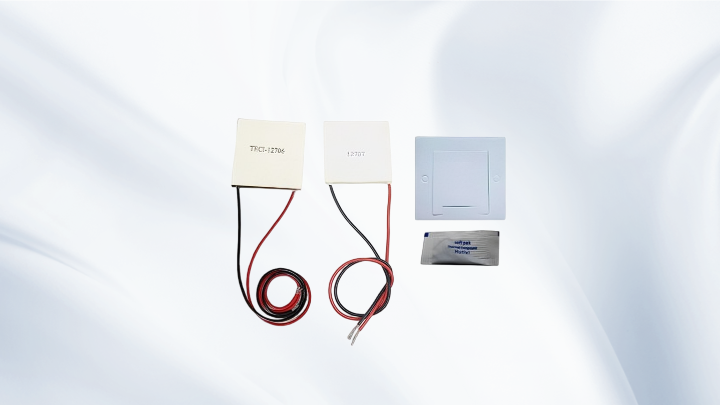
How to Evaluate a Thermoelectric Cooler Company: A Practical TEC Selection Guide
How to Evaluate a Thermoelectric Cooler Company: A Practical TEC Selection Guide
Choosing a Thermoelectric Cooler Company is rarely as simple as comparing price lists. A Peltier module is a precision semiconductor component, and its real-world performance depends on how well it is matched to the heat load, the hot-side temperature, the available power supply, and the heatsink behind it. Two suppliers can offer modules with nearly identical datasheet numbers, yet only one may be able to help you build a system that holds temperature reliably in production. This article explains what to check technically, how the core parameters interact, and what capabilities a capable TEC partner should be able to demonstrate.
What a Thermoelectric Cooler Company Actually Provides
A thermoelectric cooler company does more than sell Peltier modules. A competent manufacturer supports the full chain from die-level semiconductor material through module assembly, testing, and application engineering. In practice, that means four deliverables: a TEC module with a stable and repeatable specification, documented performance curves, application guidance on heat load and heat dissipation, and the ability to customize geometry, voltage, or sealing when a catalog part does not fit.
Thermoelectric cooling works through the Peltier effect: current flowing through a junction of dissimilar semiconductor materials moves heat from one side of the module to the other. One face becomes the cold side, the other the hot side. Because the module is a heat pump rather than a heat sink, the heat it moves must still be rejected downstream. This single fact explains most field failures in thermoelectric cooling systems, and it is the first thing a good supplier will discuss with you.
Understanding Qmax, ΔTmax, Imax, and Vmax
Every TEC datasheet is built around four headline numbers. Reading them correctly is essential before you compare suppliers.
Qmax is the maximum cooling capacity, in watts, that the module can achieve at a specified hot-side temperature when the temperature difference between the two sides is zero. It is measured at the optimum input current, with no useful temperature lift.
ΔTmax is the maximum temperature difference the module can create between its cold side and hot side, and it occurs at zero heat load. In other words, the cold side is only holding its position because nothing is being cooled.
Imax is the current at which Qmax and ΔTmax are achieved, while Vmax is the corresponding voltage at that operating point. Electrical resistance and the module's figure of merit determine how those values fall out of the semiconductor material and the pellet geometry.
Why Qmax and ΔTmax Are Not Simultaneous
This is the most common misunderstanding in thermoelectric cooling design. A module rated at a certain Qmax cannot also deliver its ΔTmax at that same operating point. As you pull more temperature difference out of the module, the available cooling capacity drops; as you reduce the temperature difference, the capacity rises. The relationship is a downward-sloping curve, not a fixed rating.
Any supplier that quotes a cooling capacity and a temperature difference as if both apply under the same condition is either simplifying dangerously or does not understand the product. A useful quote describes a specific operating point: heat load, cold-side target, hot-side temperature, input voltage or current, and the resulting coefficient of performance.
How Operating Conditions Shift Real Performance
Actual performance in an assembly rarely matches the nominal curve, because the nominal curve assumes an ideal hot-side temperature. In a real system, the hot side sits wherever the heatsink, thermal interface material, ambient temperature, and airflow allow it to sit. Raising the hot-side temperature by a few degrees changes both the achievable temperature difference and the electrical behavior of the module.
Other factors that move the operating point include input voltage and current (running a module below Imax reduces capacity but can improve efficiency), thermal resistance across every layer between the module and the ambient air, installation torque and flatness, and insulation around the cold side. For miniature TEC assemblies used in optical or sensor packaging, even the parasitic heat leak through wiring and mounting hardware matters.
Matching a Peltier Module to the Actual Heat Load
The starting point for selection is a heat-load budget, not a target temperature alone. Add up the active load you intend to cool, then add passive gains: conduction through mounting structures, radiation, convection from exposed surfaces, and self-heating from electronics inside the enclosure. A design that ignores passive gains will typically end up 10 to 20 degrees off target, and no amount of extra current will recover it efficiently.
Once the total load is known, work backwards. Decide how much temperature difference you genuinely need between the cold side and the hot side, estimate the hot-side temperature your heatsink can realistically hold, and then select a module whose capacity curve covers your load with margin at that condition. Multi-stage TEC stacks are appropriate when a single stage cannot reach the required temperature difference, while high-temperature TEC modules are used where the hot side will operate well above typical ambient. Custom TEC options make sense when the enclosure geometry, voltage rail, or sealing requirement rules out a standard footprint.
Heat Dissipation: Where Most Designs Fail
A thermoelectric cooler moves heat plus the electrical power it consumes, and all of it must leave the hot side. In rough terms, the heatsink must reject the cooling load plus the module's power consumption. That means the hot-side thermal path is usually the limiting element in the whole system.
Practical steps that make a measurable difference include using a heatsink rated well below the module's thermal resistance target, applying a thin and even layer of thermal interface material, ensuring adequate airflow or liquid cooling, and avoiding shared heat paths that let hot-side heat conduct back into the cooled volume. Sealing and insulation around the cold side reduce condensation risk and parasitic gains. Whenever a temperature problem appears, measuring the hot-side temperature first is the fastest way to identify whether the issue is the module, the load, or the thermal path.
What to Look For in a Thermoelectric Cooler Company
Technical capability shows up in the questions a supplier asks. A manufacturer that requests your heat load, target temperature, ambient conditions, available voltage, and mechanical constraints before quoting is working from engineering principles rather than a catalog page.
Application Engineering Support
Look for a partner who can review your thermal model, advise on heatsink selection, and explain the trade-off between capacity and efficiency at different input currents. This support is especially valuable for multi-stage and custom designs, where the wrong pellet geometry can leave you with a module that meets the drawing but not the thermal requirement.
Customization and Manufacturing Depth
Ask whether the company manufactures its own thermoelectric material and assembles modules in-house, or simply resells finished parts. In-house control matters for consistency, for the ability to adjust pellet count and leg length, and for supplying miniature, high-temperature, or multi-stage configurations that are not standard catalog items.
Documentation and Repeatability
Request performance curves at relevant hot-side temperatures, dimensional tolerances, sealing specifications, and incoming inspection criteria. Repeatability between lots is what keeps a production line stable, and it is a reasonable thing to verify before committing to volume.
Frequently Asked Questions
Can I run a TEC module at a higher current than Imax to get more cooling?
Running above Imax generally increases Joule heating faster than it increases cooling, so the net cooling capacity can actually fall while power consumption and hot-side load rise. It also stresses the module and shortens service life. Operating at or below Imax and improving the hot-side thermal path is almost always the better approach.
Why does my cold side never reach the datasheet ΔTmax?
ΔTmax is defined at zero heat load and an idealized hot-side temperature. Any real load, any thermal resistance between the module and the heatsink, and any heat leak into the cold side will reduce the achievable temperature difference. The measured value is normally far below the datasheet figure, and that is expected rather than a defect.
How do I choose between a single-stage and a multi-stage TEC?
Single-stage modules handle the majority of applications where the required temperature difference is moderate. Multi-stage stacks are used when a larger temperature difference is required and the heat load is relatively small, since each additional stage adds cost, height, and power consumption while reducing efficiency.
Does a higher Qmax module always cool better?
No. A high-capacity module also draws more current and generates more heat that must be removed. If the heatsink cannot handle the extra load, a large module can perform worse than a smaller one that is properly matched to the actual heat load and thermal path.
What information should I prepare before contacting a supplier?
Bring the total heat load including passive gains, the target cold-side temperature, the expected ambient and hot-side temperature, the available voltage and current, the physical envelope, and any condensation or reliability requirements. With those inputs, an experienced manufacturer can narrow the selection quickly.
Conclusion
Evaluating a Thermoelectric Cooler Company comes down to whether the supplier can reason about your thermal system, not just quote a part number. Understanding Qmax, ΔTmax, Imax, and Vmax, recognizing that maximum capacity and maximum temperature difference never occur together, and treating heat dissipation as the primary design constraint will keep a project on track. Combined with a partner who offers real application engineering and in-house customization, those principles turn thermoelectric cooling from a risky experiment into a predictable, manufacturable solution.
Article Meta Information
Meta Title: Thermoelectric Cooler Company: TEC Selection Guide
Meta Description: Learn how to evaluate a Thermoelectric Cooler Company, understand Qmax, ΔTmax, heat load, and heat dissipation, and select the right Peltier module for your design.