


Dongguan Thermoelectric Cooler Selection Guide: Matching Qmax, ΔTmax, and Heat Dissipation to Real Loads
Dongguan Thermoelectric Cooler Selection Guide: Matching Qmax, ΔTmax, and Heat Dissipation to Real Loads
A Dongguan Thermoelectric Cooler is often selected from a datasheet by looking at the highest cooling capacity or the largest temperature difference. That approach can lead to an undersized heatsink, excessive power consumption, or a system that cannot hold temperature in real operating conditions. A thermoelectric cooler is a heat pump, not a cooling block. Its performance depends on the heat load, cold-side temperature, hot-side temperature, input voltage and current, thermal interface material, and the ability of the heatsink to reject heat. This guide explains the practical selection logic behind a reliable Peltier cooling design.
Start with the Real Heat Load, Not the Datasheet Headline
Before comparing any TEC module, define the actual heat load that must be removed from the cold side. The heat load may include active electrical power from components, passive heat leak through insulation, thermal radiation, convection from ambient air, and heat conducted through mounting hardware or wires. In many Peltier cooler projects, the passive heat leak is underestimated, especially in small enclosures where the cold side is close to the warm side.
The required cooling capacity is not simply the heat generated by the target component. It is the total heat that must be pumped from the cold side at the target temperature difference. If the cold side must stay below ambient, the TEC must pump both the component heat and the heat leaking into the cold zone. For this reason, a thermoelectric cooler selected only by Qmax may be too small in practice. Qmax is the maximum heat pumping rate at zero temperature difference, and it is a reference point, not a guaranteed operating capacity.
How Qmax, ΔTmax, Imax, and Vmax Work Together
Datasheets commonly list Qmax, ΔTmax, Imax, and Vmax. Each parameter describes a different limit. Qmax is the maximum cooling capacity, normally stated at a specific hot-side temperature and at ΔT = 0. ΔTmax is the maximum temperature difference between the cold side and hot side, normally stated at zero heat load. Imax is the current associated with the maximum cooling condition, and Vmax is the corresponding voltage. These values help engineers compare modules, but they do not describe a normal operating point.
A Peltier module cannot normally achieve Qmax and ΔTmax at the same time. When the temperature difference increases, the cooling capacity decreases. When the heat load increases, the achievable temperature difference decreases. The actual operating point lies somewhere between these limits and depends on the hot-side temperature, cold-side temperature, input power, heatsink performance, and thermal resistance of the entire assembly. A useful selection process therefore asks: at the required ΔT and realistic hot-side temperature, how much cooling capacity can the module deliver, and what input power is needed?
Why Hot-Side Heat Dissipation Defines Dongguan Thermoelectric Cooler Performance
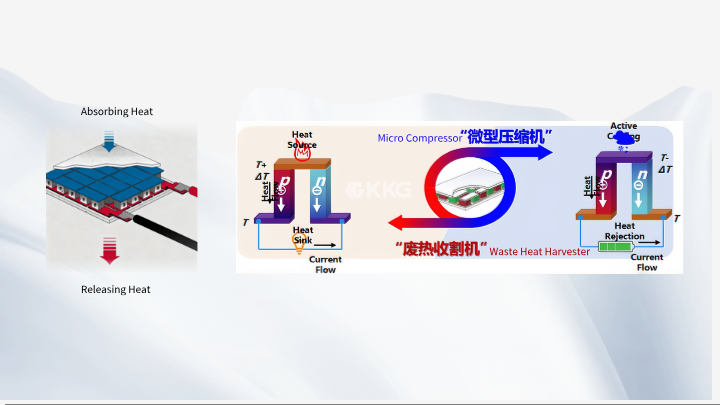
The hot side of a Dongguan Thermoelectric Cooler is not a secondary detail. It is a primary design constraint. A TEC moves heat from the cold side to the hot side and also generates Joule heat from the input current. Both quantities must be removed by the heatsink. If the hot side rises, ΔT shrinks, cooling capacity falls, and power consumption may rise. In severe cases, the module can enter thermal runaway or fail prematurely.
When reviewing a thermoelectric cooling design, calculate the total heat rejected at the hot side: the pumped heat load plus the electrical power input. Then compare that value with the heatsink performance at the available ambient temperature and airflow. Pay attention to thermal resistance, mounting pressure, thermal interface material, and air path. A high-Qmax module paired with an inadequate heatsink will usually perform worse than a smaller module with a well-designed hot-side path. This is especially true in enclosed electronics, where ambient temperature around the heatsink may be higher than room temperature.
Voltage, Current, and Power Consumption in TEC Selection
Voltage and current selection should follow the thermal requirement, not precede it. A TEC module may be rated for a certain Vmax and Imax, but the actual operating voltage and current should be chosen to meet the cooling load at the target ΔT without excessive oversizing. Running a module at maximum current is not automatically better. Higher current increases heat pumping, but it also increases electrical power input and hot-side heat rejection, which can reduce net cooling performance if the heatsink cannot keep up.
For battery-powered or energy-sensitive systems, compare the coefficient of performance at the intended operating point rather than at datasheet extremes. Consider whether the system can use a lower current with a larger cold-side interface, improved insulation, or a more efficient heatsink. In many cases, reducing parasitic heat load is more effective than increasing TEC current. The right choice balances cooling capacity, temperature difference, power consumption, and available space.
Practical Selection Workflow for a Peltier Cooler
Begin by defining the target cold-side temperature, expected ambient temperature, and total heat load. Then estimate the required ΔT under worst-case conditions. Select a TEC module whose performance curve shows useful capacity at that ΔT with a realistic hot-side temperature. Do not rely on Qmax alone. Next, design the hot-side heatsink so that the module can reject both the pumped heat and the input power. Confirm that the thermal interface material, mounting method, and insulation strategy support the intended temperature difference.
After the first design pass, review the operating voltage and current against the available power supply. Check startup conditions, condensation risk, and control strategy. If the application needs precise temperature stability, a closed-loop controller with a suitable sensor and current limit is often more useful than a larger module. For projects with space constraints, compare miniature TEC options only after the heat load and heatsink path are understood. A smaller module can work well when the cold-side mass and heat leak are controlled.
Application Notes: Miniature, High-Temperature, Multi-Stage, and Custom TEC Options
Different applications place different demands on a thermoelectric cooler. Miniature TEC modules are common in compact sensor cooling, laser diode temperature control, and portable instruments, where the heat load is small but the cold-side temperature must be stable. High-temperature TEC modules are used where the hot-side or ambient condition is elevated and standard modules may not be suitable. Multi-stage TEC modules can achieve larger temperature differences, but they require careful heat rejection and usually have lower efficiency. Custom TEC designs may be appropriate when mounting geometry, sealing, lead configuration, or thermal interface requirements cannot be met by a standard module.
In KKG's TEC product categories, these options should be evaluated as part of the same thermal management problem, not as isolated components. The module, heatsink, insulation, and control electronics must work together. If a standard Peltier cooler cannot meet the mechanical or thermal requirement, a custom TEC approach may reduce assembly risk and improve repeatability, but it should be based on measured heat load and a clearly defined operating condition.
Common Engineering Mistakes to Avoid
One common mistake is selecting a TEC module by Qmax while ignoring the hot-side temperature. Another is assuming that a higher current always produces more net cooling. A third is using a datasheet ΔTmax as if it were available with a real heat load. These assumptions often lead to oversized power supplies, undersized heatsinks, and unstable temperature control. It is also important not to ignore thermal interface material quality, mounting pressure, and condensation protection. A technically suitable module can still fail in the field if the installation conditions are poor.
Frequently Asked Questions
Can I operate a Dongguan Thermoelectric Cooler at both Qmax and ΔTmax?
No. Qmax is the maximum cooling capacity at zero temperature difference, while ΔTmax is the maximum temperature difference at zero heat load. They represent different limit conditions and are not normally achieved at the same operating point. Real performance depends on heat load, hot-side temperature, cold-side temperature, input power, and heatsink performance.
Why does my Peltier cooler lose cooling capacity after assembly?
The most common causes are insufficient hot-side heat dissipation, poor thermal contact, heat leak into the cold side, or a higher ambient temperature than expected. Check the heatsink thermal resistance, thermal interface material, mounting pressure, insulation, and air path before changing the TEC module.
Should I choose a module with higher Qmax or higher ΔTmax?
Neither value should be used alone. Define the required heat load and temperature difference first. Then compare modules at the expected hot-side temperature and operating current. A module with a lower Qmax may perform better if it matches the heatsink and power budget more closely.
How much power does a thermoelectric cooler consume?
Power consumption depends on the operating voltage and current, which in turn depend on the required cooling capacity and temperature difference. The hot side must reject both the pumped heat and the electrical input power. For energy-sensitive designs, reduce parasitic heat load and optimize the heatsink before increasing TEC current.
When should I consider a custom TEC?
Consider a custom TEC when standard module dimensions, lead configuration, sealing, mounting, or thermal interface requirements do not fit the application. A custom design should be based on a clearly defined heat load, target temperature difference, ambient conditions, and assembly method.
Conclusion
A Dongguan Thermoelectric Cooler performs best when it is selected as part of a complete thermal system. Qmax and ΔTmax are useful reference values, but they do not replace application-specific analysis of heat load, hot-side temperature, thermal resistance, voltage, current, and power consumption. By defining the real load, designing adequate heat dissipation, and validating the operating point, engineers can avoid common Peltier cooler selection errors and build a more stable thermoelectric cooling solution.
SEO Meta Information
META TITLE: Dongguan Thermoelectric Cooler Selection Guide for TEC Design
META DESCRIPTION: Learn how to specify a Dongguan Thermoelectric Cooler by balancing heat load, Qmax, ΔTmax, voltage, current, and hot-side heat dissipation for reliable TEC performance.
