


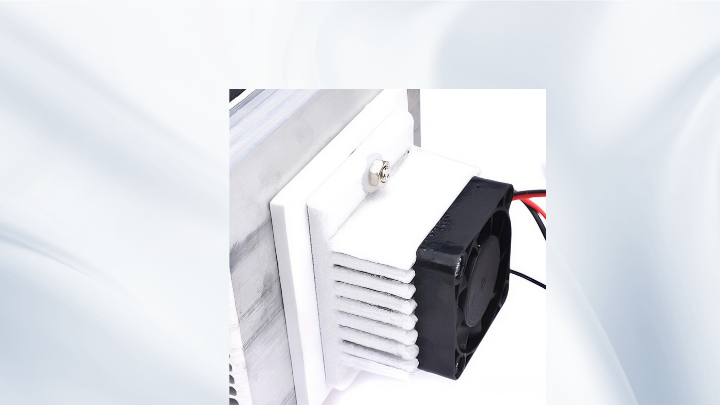
China Thermoelectric Cooler Selection Guide for TEC Design
China Thermoelectric Cooler Selection Guide for TEC Design
A China thermoelectric cooler is useful only when its operating point matches the application. Buyers often compare Qmax first, but a TEC module is part of a thermal system that includes the cold-side interface, hot-side heatsink, power supply, and control. This guide explains how to choose a China Thermoelectric Cooler by working from heat load and temperature difference toward module ratings, electrical limits, and heat dissipation.
What a China Thermoelectric Cooler Datasheet Can and Cannot Tell You
A datasheet for a Peltier module usually lists Qmax, ΔTmax, Imax, Vmax, and sometimes electrical resistance. These values are reference points from defined test conditions. They help compare thermoelectric cooler families, but they do not guarantee that the same module will deliver the same performance in your enclosure.
The datasheet cannot fully describe the real system. Actual cooling capacity depends on the heat load, hot-side temperature, cold-side temperature, input voltage, input current, heatsink performance, thermal resistance at both interfaces, thermal interface material, installation method, and ambient temperature. A Peltier cooler that performs well on a bench may underperform in a sealed enclosure if heat cannot leave the hot side.
Why Qmax and ΔTmax Are Not Simultaneous Operating Points
Qmax is the maximum heat pumping rate, normally defined at zero temperature difference between the cold side and hot side under rated conditions. ΔTmax is the maximum temperature difference, normally defined at zero heat load. These two conditions are different. In practical thermoelectric cooling, the module operates somewhere between them: it pumps a finite heat load while maintaining a finite temperature difference.
This is one of the most common misunderstandings in TEC selection. A module rated for a high Qmax does not mean it can hold a large temperature difference while removing a large heat load. Likewise, a high ΔTmax rating does not mean the module will cool a real load quickly. The operating point must be estimated from the application requirements, then checked against the module curve or supplier data for the relevant hot-side temperature and input conditions.
China Thermoelectric Cooler Selection: From Heat Load to Operating Point
A practical selection process starts with the thermal problem, not with a product list. The goal is to find a TEC module that can maintain the required cold-side temperature under the worst-case heat load and ambient condition while staying within electrical and thermal limits.
1. Define the real heat load
Include the active load, such as electronics or a sample chamber, plus passive gains from conduction, radiation, convection, and any heat bridges through cables, fasteners, or seals. If the cold side is not well insulated, the required cooling capacity may be much higher than the load itself. For small enclosures, even a few watts of leakage can be significant.
2. Set the target temperatures
Define the required cold-side temperature and the maximum expected hot-side temperature. The temperature difference between them drives the TEC selection. Hot-side temperature is not a fixed number; it depends on ambient temperature, heatsink size, airflow, and the total heat rejected. A realistic hot-side estimate is necessary before comparing modules.
3. Add engineering margin
Select a module with enough capacity for startup, aging, dust, and variation in ambient conditions, but avoid excessive oversizing. A larger Peltier cooler may draw more power consumption and require a larger heatsink. The appropriate margin depends on the application and should be confirmed by prototype testing.
4. Check the module family
For small or space-constrained products, a miniature TEC may be appropriate. For high ambient or high hot-side conditions, a high-temperature TEC may be needed. For very large temperature differences, a multi-stage TEC can be considered, but it brings additional complexity and lower efficiency. When standard modules do not fit the mechanical or thermal envelope, a custom TEC may be the practical route. KKG organizes relevant TEC categories around these design problems, so engineers can narrow the format before comparing detailed specifications.
Electrical Selection: Voltage, Current, Imax, and Vmax
Imax and Vmax describe the electrical operating range associated with the module rating conditions. They are not simple recommendations to run the module at maximum current and voltage. In many designs, the best operating point is below the maximum because higher current increases Joule heating inside the module and can reduce net cooling efficiency.
The selected voltage and current must match the available power supply and control method. A semiconductor cooling system may use constant voltage, constant current, PWM, or closed-loop temperature control. Each approach affects ripple, stability, and efficiency. The engineer should also calculate approximate power consumption and confirm that the supply, wiring, connectors, and thermal path can handle it. If the module is operated well below its rated conditions, confirm that the resulting cooling capacity is still sufficient at the required temperature difference.
Heat Dissipation and Hot-Side Thermal Management
Heat dissipation is often the limiting factor in a thermoelectric cooling design. The hot side must reject both the heat pumped from the cold side and the electrical power consumed by the module. In simple terms, the hot-side heat load is the cold-side heat load plus input power. If this heat is not removed effectively, the hot side rises, the achievable temperature difference falls, and the cooler appears weak even if the module is electrically healthy.
Heatsink selection should consider thermal resistance, airflow, ambient temperature, mounting orientation, and dust or condensation risks. Thermal interface material matters on both the cold side and hot side, but it cannot compensate for an undersized heatsink. Good thermal management also includes insulating the cold side from ambient heat and avoiding unnecessary thermal bridges. In many troubleshooting cases, the TEC module is not the root cause; the hot-side path is.
Practical Checks Before Approving a Peltier Cooler Design
Before finalizing a China Thermoelectric Cooler selection, review the complete thermal path. Check that the cold-side load is estimated realistically, the target temperature difference is achievable at the expected hot-side temperature, the heatsink can reject the total heat load, and the power supply matches the required voltage and current. Confirm that the module is mounted with appropriate pressure and interface material, without excessive mechanical stress.
Run a prototype test at the worst-case ambient condition and record cold-side temperature, hot-side temperature, input voltage, input current, and cooldown time. Compare the measured operating point with the design estimate. A useful rule is to treat the TEC module, heatsink, insulation, and control as one system. If one part is changed, the others may need review.
Frequently Asked Questions
Can a China Thermoelectric Cooler reach Qmax and ΔTmax at the same time?
No. Qmax is defined at zero temperature difference, while ΔTmax is defined at zero heat load. In normal operation, the module works between these points, and actual performance depends on heat load, hot-side temperature, cold-side temperature, voltage, current, heatsink performance, and thermal resistance.
What information is needed to select a TEC module?
Provide the heat load, required cold-side temperature, expected hot-side or ambient temperature, available voltage and current, size limits, duty cycle, control method, and mechanical constraints. These details allow an engineer to estimate the operating point and choose a suitable Peltier cooler family.
Why does my thermoelectric cooler not reach the expected temperature?
Common causes include underestimated heat load, poor hot-side heat dissipation, high ambient temperature, inadequate thermal interface material, poor mounting, thermal bridges, or insufficient input current. Check the hot-side temperature first, because a rising hot side directly reduces achievable cooling.
Does higher current always produce more cooling?
No. Increasing current raises heat pumping, but it also increases electrical losses and heat generation inside the module. Beyond a practical point, extra current may not improve net cooling and can reduce efficiency. The correct operating current depends on the module, heat load, and temperature difference.
When should a miniature, high-temperature, multi-stage, or custom TEC be considered?
A miniature TEC is useful for small loads and tight spaces. A high-temperature TEC may suit high hot-side conditions. A multi-stage TEC may be relevant for large temperature differences. A custom TEC can fit special mechanical or thermal requirements. The choice should follow the thermal design, not the other way around.
Conclusion
Selecting a China Thermoelectric Cooler is an engineering exercise in matching heat load, target temperature difference, electrical input, and heat dissipation. Qmax and ΔTmax are useful reference values, but they are not simultaneous operating points. The practical result depends on the hot-side temperature, cold-side temperature, thermal resistance, interface materials, and the complete cooling system. By working from the application requirements and validating the design with realistic testing, engineers can choose a TEC module that delivers stable performance rather than only attractive datasheet numbers.
META TITLE: China Thermoelectric Cooler Selection Guide for TEC Design
META DESCRIPTION: Learn how to select a China thermoelectric cooler by balancing Qmax, ΔTmax, heat load, voltage, current, and heat dissipation for reliable TEC performance.
